Generative Typography
First appeared 1999 · John Maeda — Computational typography runs from 1960s computer-driven phototypesetting to reactive/kinetic type popularized by John Maeda (Design By Numbers, 1999) and the Processing lineage. Diffuse, multi-rooted. · timeline ↗
community / folk Name — A descriptive category label, not a coined or eponymous name; no single coiner of the term is attested.
In one line Form-making by parametrically transforming and arranging letters and words — spanning logos, posters and motion graphics as well as abstract lettering.
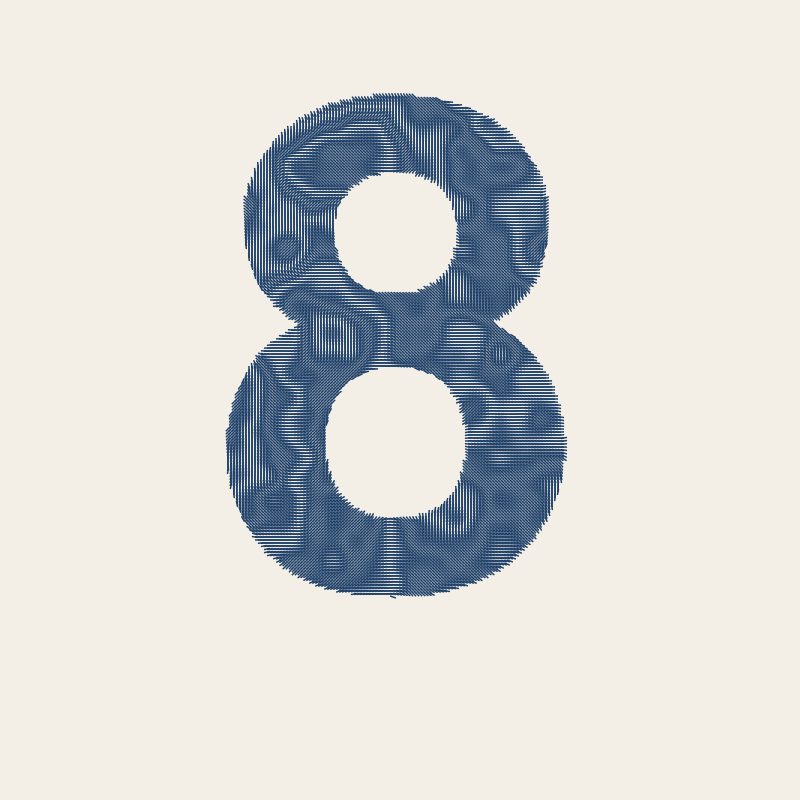
The code
The actual sketch behind the demo above — sandboxed and reproducible. This is the whole thing.
typography-generative/index.html
const SEED = Math.floor(Math.random()*1e9);

// Generative typography: a glyph is rasterised into a point cloud (via an
// offscreen text buffer), then each point is re-drawn as a small rotated
// stroke whose angle follows a noise field — letterforms made of marks.
const WORD = ['A','G','Z','&','@','%','8','Q'];

function setup() {
  randomSeed(SEED); noiseSeed(SEED);
  const s = Math.min(windowWidth, windowHeight);
  createCanvas(s, s);
  background('#f3efe6');

  const g = createGraphics(s, s);
  g.pixelDensity(1);
  g.background(255);
  g.fill(0);
  g.textAlign(CENTER, CENTER);
  g.textStyle(BOLD);
  g.textSize(s * 0.86);
  g.text(WORD[Math.floor(random(WORD.length))], s/2, s*0.46);
  g.loadPixels();

  const palette = ['#1a1a2e', '#c1502e', '#1f4068', '#e2a829'];
  const col = random(palette);
  stroke(col);
  strokeCap(ROUND);
  const step = Math.max(3, Math.floor(s / 220));
  strokeWeight(step * 0.5);

  for (let y = 0; y < s; y += step) {
    for (let x = 0; x < s; x += step) {
      const idx = 4 * (y * s + x);
      if (g.pixels[idx] < 128) { // inside the glyph (dark)
        const a = noise(x*0.006, y*0.006) * TWO_PI * 2;
        const len = step * 1.6;
        push();
        translate(x, y);
        rotate(a);
        line(-len/2, 0, len/2, 0);
        pop();
      }
    }
  }
}How it works
Treat type as geometry to be driven by parameters and rules: 1. Source the letterforms — variable-font axes (weight, width, slant), outline paths sampled into points, or glyphs rasterised to a grid. 2. Transform: modulate per glyph or per point — jitter, skew, repeat, displace along a noise/flow field, or interpolate variable-font axes from a parameter or the audio/time. 3. Lay out: place along a path, grid or packing, resolving spacing/kerning, and optionally let letters overlap or collide. Because the rules are parametric, one system yields a whole family of posters or an animated title; seeding the parameters makes each output unique yet reproducible.
Parameters
glyphSet: array — The characters or letterforms drawn.fontSize: number — Type size.layout: string — How glyphs are placed (grid, flow, path-following).caseRule: string — The grammar/rule driving which glyphs appear.
Lineage
Frequently combined with
- Geometric / Hexagonal Tiling · 4 works
- Modular Assembly / Parametric Character · 4 works
- Plotter-style Hatching · 3 works
- 3D Mesh / Geometry · 2 works
- Polygon Mosaic · 2 works
- Generative Typography / ASCII · 1 work
- Domain Warping · 1 work
- Symmetric Blob / Rorschach · 1 work
- HSL / Hue Cycle · 1 work
- Wave Function Collapse · 1 work
- Truchet Tiles · 1 work
- Fractal / Recursive Subdivision · 1 work
Works using this algorithm (19)


Last updated 2026-07-16