Symmetric Blob / Rorschach
First appeared 1982 · Jim Blinn — Smooth "blobby" implicit-surface forms derive from metaballs, introduced by Jim Blinn ("A Generalization of Algebraic Surface Drawing", 1982) and the soft-object/implicit-surface literature that followed. Diffuse primitive. · timeline ↗
community / folk Name — A descriptive index label in the implicit-surface / metaball family (Blinn's "blobby" model, 1982); not an established or coined name.
In one line Growing a random shape and mirroring it across an axis to make ink-blot-like organic forms (Rorschach symmetry) — the style behind works such as Cryptoblots.
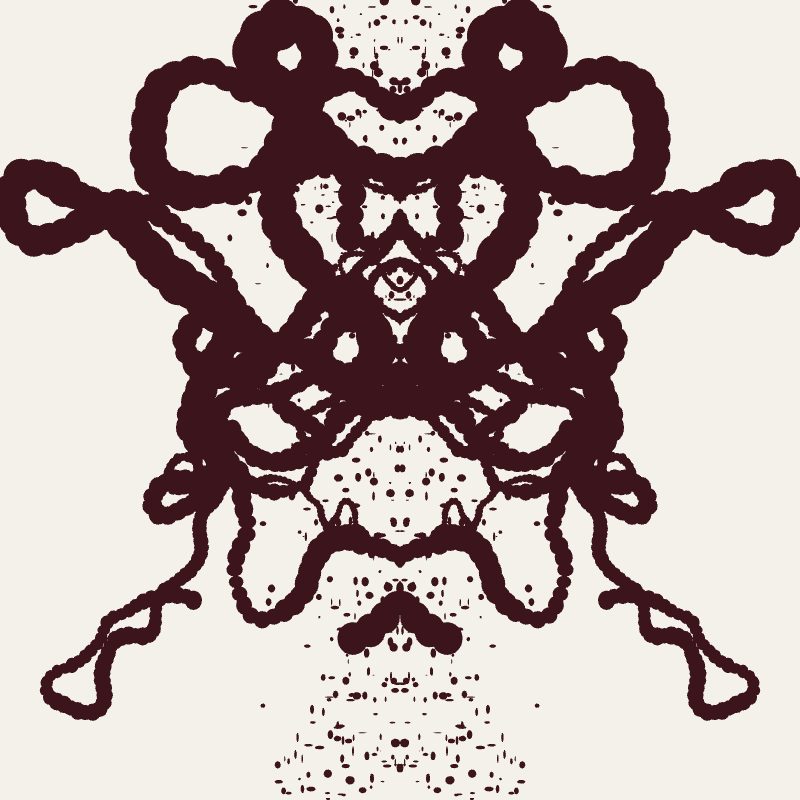
The code
The actual sketch behind the demo above — sandboxed and reproducible. This is the whole thing.
symmetric-blob/index.html
const SEED = Math.floor(Math.random()*1e9);

// Rorschach inkblot (Cryptoblots-style): grow random splats on the left half,
// then mirror across the vertical axis for bilateral symmetry.
function setup() {
  randomSeed(SEED); noiseSeed(SEED);
  const s = Math.min(windowWidth, windowHeight);
  createCanvas(s, s);
  background('#f4f1ea');
  noStroke();

  const ink = random([
    [18, 18, 24], [22, 38, 60], [60, 20, 28], [20, 40, 30],
  ]);

  // Render the left half into a buffer, then mirror.
  const half = createGraphics(Math.ceil(s/2), s);
  half.pixelDensity(1);
  half.noStroke();
  half.fill(ink[0], ink[1], ink[2]);

  // a handful of "blot clusters": each is a random walk dropping overlapping
  // ellipses with size driven by noise — organic ink spread.
  const clusters = 5 + Math.floor(random(4));
  for (let c = 0; c < clusters; c++) {
    let x = random(half.width*0.45, half.width*0.98);
    let y = random(s*0.15, s*0.85);
    const steps = 120 + Math.floor(random(160));
    let r = random(s*0.02, s*0.06);
    for (let i = 0; i < steps; i++) {
      const a = noise(c*10 + i*0.05) * TWO_PI * 2;
      x += Math.cos(a) * r * 0.5;
      y += Math.sin(a) * r * 0.5;
      const rr = r * (0.5 + noise(c*5 + i*0.1));
      half.ellipse(x, y, rr, rr*random(0.8, 1.2));
      r *= 0.995;
      if (x < 0 || y < 0 || y > s) break;
    }
  }

  // splatter dots near the seam
  for (let i = 0; i < 400; i++) {
    const x = half.width - Math.abs(randomGaussianish()) * half.width*0.5;
    const y = random(s);
    half.ellipse(x, y, random(1, s*0.012), random(1, s*0.012));
  }

  image(half, 0, 0);
  push();
  translate(s, 0);
  scale(-1, 1);
  image(half, 0, 0);
  pop();
}

function randomGaussianish() {
  return (random() + random() + random() - 1.5) / 1.5;
}How it works
1. Grow a blob on one half of the canvas — accrete random particles, splat overlapping circles/strokes, run a noisy radial outline, or smear "ink" with a random walk, all seeded from the token's random number. 2. Mirror it across the central axis (reflect x about the centre line, or use several reflection axes for kaleidoscopic n-fold symmetry) so the two halves match like a folded inkblot. 3. Composite the halves and finish — bleed, texture, or a limited palette. The brain reads the bilateral symmetry as a face/creature even though the form is pure noise, which is exactly the Rorschach effect the technique exploits.
Parameters
vertexCount: number — Number of outline points around the blob.noiseAmount: number — How far each vertex is pushed out to deform the base circle.symmetry: string — The mirror/rotational symmetry imposed (e.g. bilateral).radius: number — Base radius before deformation.
Lineage
Frequently combined with
- Bezier / Catmull-Rom Splines · 3 works
- Fractal / Recursive Subdivision · 2 works
- Generative Typography · 1 work
- Modular Assembly / Parametric Character · 1 work
Works using this algorithm (5)


Last updated 2026-07-16