Polygon Mosaic
Triangulated / low-poly mosaic aesthetics build on Delaunay triangulation (Boris Delaunay, 1934) and Voronoi partitioning, popularized in 2010s generative and graphic design. Diffuse; no single first.
community / folk Name — A descriptive category label, not a coined or eponymous name; no single coiner of the term is attested.
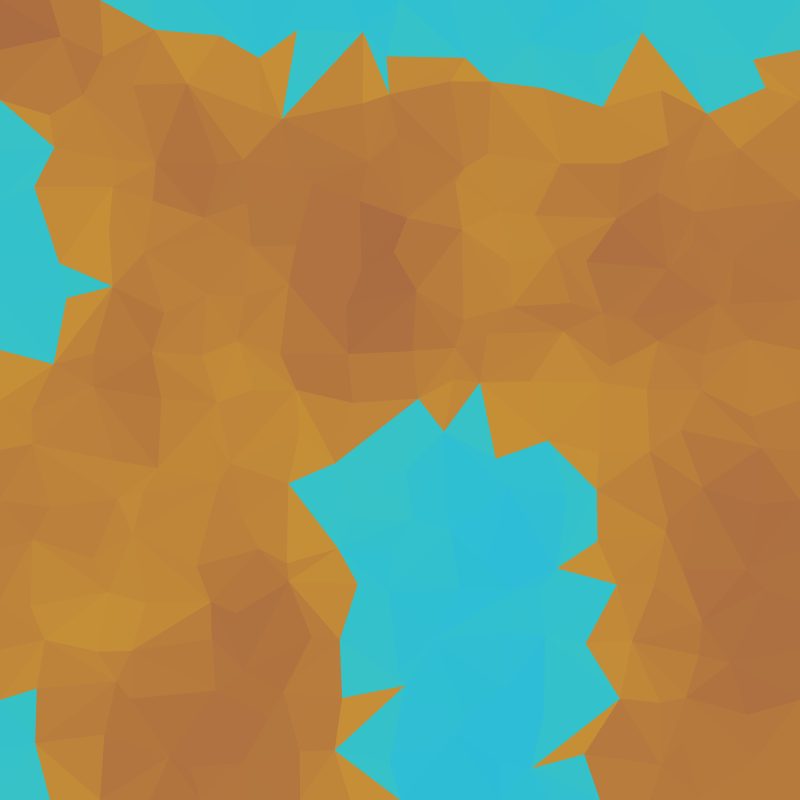
In one line A low-poly mosaic composition that tiles the canvas with coloured polygons — usually the cells of a Voronoi/Delaunay partition of random or feature points.
The code
The actual sketch behind the demo above — sandboxed and reproducible. This is the whole thing.
polygon-mosaic/index.html
const SEED = Math.floor(Math.random()*1e9);

// Low-poly mosaic: triangulate jittered grid points, fill each triangle by
// sampling an underlying noise-based colour field at its centroid.
function setup() {
  randomSeed(SEED); noiseSeed(SEED);
  const s = Math.min(windowWidth, windowHeight);
  createCanvas(s, s);
  colorMode(HSB, 360, 100, 100);
  noStroke();

  const hueA = random(360), hueB = (hueA + random(60, 180)) % 360;
  const G = 16;
  const step = s / G;
  // jittered grid of points
  const grid = [];
  for (let j = 0; j <= G; j++) {
    grid[j] = [];
    for (let i = 0; i <= G; i++) {
      const edge = i === 0 || j === 0 || i === G || j === G;
      const jit = edge ? 0 : step * 0.42;
      grid[j][i] = { x: i*step + random(-jit, jit), y: j*step + random(-jit, jit) };
    }
  }
  for (let j = 0; j < G; j++) {
    for (let i = 0; i < G; i++) {
      const a = grid[j][i], b = grid[j][i+1], c = grid[j+1][i+1], d = grid[j+1][i];
      // split quad into 2 triangles (alternating diagonal)
      if ((i + j) % 2 === 0) { fillTri(a, b, c); fillTri(a, c, d); }
      else { fillTri(a, b, d); fillTri(b, c, d); }
    }
  }

  function fillTri(p, q, r) {
    const cx = (p.x+q.x+r.x)/3, cy = (p.y+q.y+r.y)/3;
    const n = noise(cx*0.004, cy*0.004);
    const h = (n < 0.5 ? hueA : hueB) + (n - 0.5) * 40;
    fill((h + 360) % 360, 55 + n*35, 60 + n*35);
    triangle(p.x, p.y, q.x, q.y, r.x, r.y);
  }
}How it works
1. Scatter a set of points — uniformly random, blue-noise, or biased toward an image's edges/detail so the mosaic follows content. 2. Partition the plane on those points: a Voronoi diagram gives convex cells, or a Delaunay triangulation gives triangles ("low-poly"). 3. Fill each polygon with a single colour — a flat random hue, or the average / centre-sample colour of a source image inside that cell — and optionally stroke the edges. Fewer points give a chunky abstract mosaic; more points approach the original image. Animating the points or their colours makes the mosaic shimmer.
Parameters
siteCount: number — Number of points seeding the polygonal cells.smoothing: number — How much cell edges are rounded or relaxed.palette: array — The colours assigned to the cells.
Lineage
Frequently combined with
- Geometric / Hexagonal Tiling · 2 works
- Fractal / Recursive Subdivision · 2 works
- Bezier / Catmull-Rom Splines · 2 works
- Generative Typography · 2 works
- Plotter-style Hatching · 2 works
- Circle Packing · 2 works
- Truchet Tiles · 1 work
- Perlin / Simplex Noise · 1 work
- Physics Simulation · 1 work
- Modular Assembly / Parametric Character · 1 work
- Multi-color Modular Truchet · 1 work
Works using this algorithm (12)


Last updated 2026-07-16