3D Mesh / Geometry
Polygonal 3-D mesh modelling is foundational computer graphics from the early 1970s (e.g. Martin Newell's Utah teapot, 1975). A general CG primitive with no single first in generative art.
community / folk Name — A descriptive category label, not a coined or eponymous name; no single coiner of the term is attested.
In one line Building, deforming and rendering 3D meshes (with three.js, regl, etc.) as the core of a piece — covering procedural geometry generation and instanced drawing.
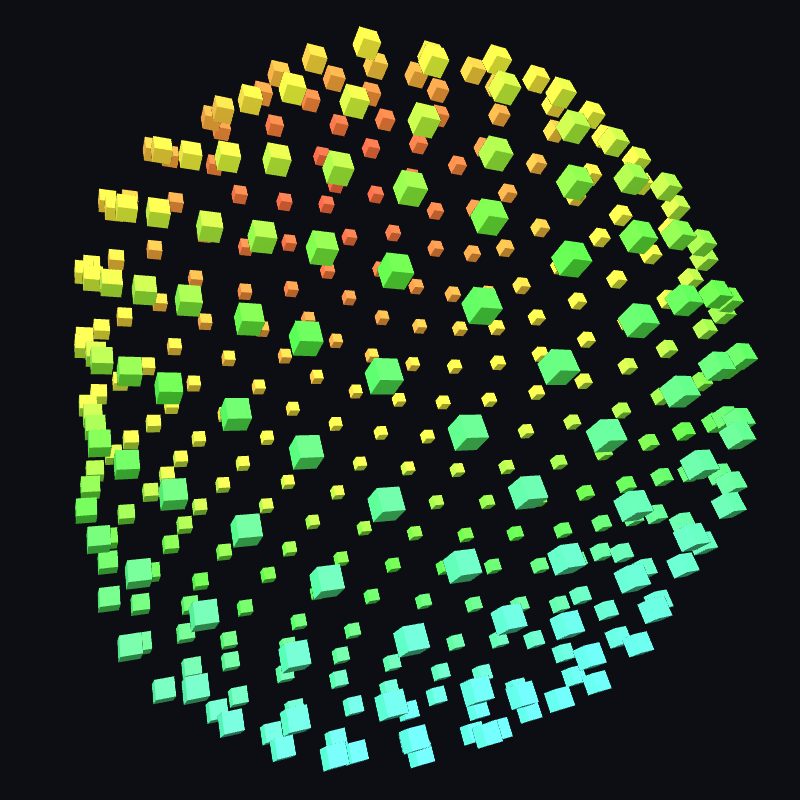
The code
The actual sketch behind the demo above — sandboxed and reproducible. This is the whole thing.
mesh-3d/index.html
const SEED = Math.floor(Math.random()*1e9);

// p5 WEBGL: a rotating displaced sphere of cubes (instanced look) with
// per-instance hue. Demonstrates 3D mesh assembly + lighting.
let pts = [];
let hueBase;

function setup() {
  randomSeed(SEED); noiseSeed(SEED);
  const s = Math.min(windowWidth, windowHeight);
  createCanvas(s, s, WEBGL);
  colorMode(HSB, 360, 100, 100);
  hueBase = random(360);

  // Fibonacci sphere of points, radius modulated by noise.
  const N = 360;
  const R = s * 0.30;
  const ga = Math.PI * (3 - Math.sqrt(5));
  for (let i = 0; i < N; i++) {
    const y = 1 - (i / (N - 1)) * 2;
    const r = Math.sqrt(1 - y * y);
    const th = ga * i;
    const nx = Math.cos(th) * r, nz = Math.sin(th) * r;
    const disp = 1 + noise(nx * 1.2 + 9, y * 1.2, nz * 1.2) * 0.5;
    pts.push({ x: nx * R * disp, y: y * R * disp, z: nz * R * disp, n: y });
  }
}

function draw() {
  background(230, 40, 8);
  const s = width;
  ambientLight(0, 0, 35);
  directionalLight(0, 0, 100, 0.4, 0.6, -0.7);
  pointLight((hueBase + 60) % 360, 60, 100, 0, 0, s);

  rotateY(frameCount * 0.006);
  rotateX(Math.sin(frameCount * 0.004) * 0.5 + 0.4);

  noStroke();
  const bsz = s * 0.018; // NB: don't shadow p5's box()
  for (const p of pts) {
    push();
    translate(p.x, p.y, p.z);
    const h = (hueBase + (p.n + 1) * 90) % 360;
    ambientMaterial(h, 65, 92);
    box(bsz);
    pop();
  }
}How it works
A mesh is vertices (positions, plus normals/UVs/colours) joined into faces by an index list. A generative 3D piece typically: 1. Generates geometry — start from a primitive, or build vertices procedurally (extrude a path, revolve a profile, subdivide, march an isosurface, or grow a form), and compute normals. 2. Deforms it — displace vertices by noise, a flow field, or per-frame physics; morph between targets; or animate in a vertex shader on the GPU. 3. Renders — feed the buffers to the GPU, shade with materials/lighting, and draw (optionally instanced for many copies); a camera projects it to 2D. The look comes from how vertices are placed and moved; keeping the mesh on the GPU and only updating attributes keeps large geometry real-time.
Parameters
vertexCount: number — Number of vertices in the mesh.subdivisions: number — How many times the base surface is refined.primitive: string — Base solid the mesh is built from (icosahedron, plane, etc.).displacement: number — How far vertices are pushed along their normals.
Lineage
Frequently combined with
- Fragment Shader (GLSL) · 25 works
- Instanced Geometry · 12 works
- Perlin / Simplex Noise · 10 works
- Raymarching with SDFs · 6 works
- Modular Assembly / Parametric Character · 5 works
- Particle System · 5 works
- Plotter-style Hatching · 3 works
- Bezier / Catmull-Rom Splines · 2 works
- Generative Typography · 2 works
- Audio-Reactive · 2 works
- Domain Warping · 2 works
- Flow Field / Vector Field · 2 works
Works using this algorithm (57)


Last updated 2026-07-16