Multi-color Modular Truchet
First appeared 1704 · Sébastien Truchet — Generalization of Truchet tiles (Sébastien Truchet, 1704; multi-tile sets popularized by Cyril Stanley Smith, 1987). · timeline ↗
community / folk Name — Descriptive variant name in the Truchet-tile family (Truchet, 1704); a compound descriptive label, not a separate eponym.
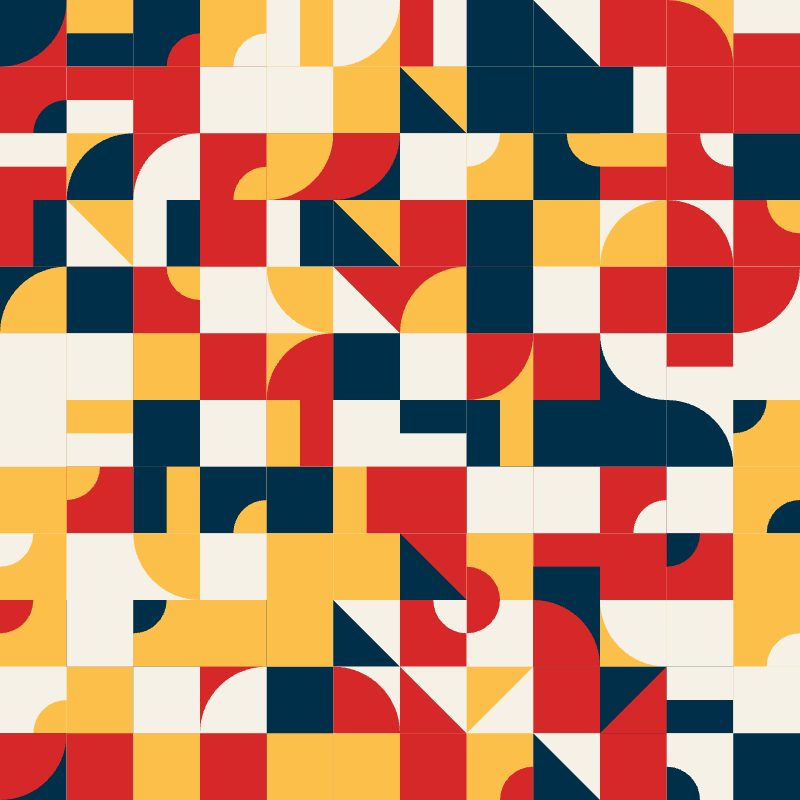
In one line A multi-template Truchet tiling: a small set of square, triangle and quarter- circle motifs, each placed in 4 rotations and several variants, filled with flat multi-colour palettes for a Bauhaus / mid-century look (e.g. Harvey Rayner / patterndotco).
The code
The actual sketch behind the demo above — sandboxed and reproducible. This is the whole thing.
truchet-multitile/index.html
const SEED = Math.floor(Math.random()*1e9);

const PALETTES = [
  // Bauhaus / patterndotco-ish
  ['#fafaf2', '#1ecbb0', '#e8253a', '#0d1b2a'],
  // Mid-century warm
  ['#f5e9d3', '#e8a87c', '#c38d9e', '#41b3a3'],
  // Memphis bright
  ['#fdfcdc', '#ffd166', '#ef476f', '#073b4c'],
  // Bauhaus primaries
  ['#f4f1de', '#e07a5f', '#3d405b', '#81b29a'],
  // Mono navy + crimson
  ['#f5f1e6', '#d62828', '#003049', '#fcbf49'],
];

function setup() {
  randomSeed(SEED);
  const s = Math.min(windowWidth, windowHeight);
  createCanvas(s, s);
  noStroke();

  const palette = PALETTES[Math.floor(random(PALETTES.length))];
  background(palette[0]);

  // Each cell: pick (bg, fg) from palette, then a tile template + rotation.
  // 7 templates × 4 rotations = 28 distinct visible tiles.
  const N = 12;
  const cs = width / N;

  for (let i = 0; i < N; i++) {
    for (let j = 0; j < N; j++) {
      const x = i * cs;
      const y = j * cs;

      // Pick two distinct colors. p5's shuffle() returns a new shuffled
      // array by default — capture the return value.
      const cs2 = shuffle(palette);
      const bg = cs2[0];
      const fg = cs2[1];

      // Background square
      fill(bg);
      rect(x, y, cs, cs);

      // Foreground tile template (1..6; 0 means "no overlay")
      const t = Math.floor(random(7));
      if (t === 0) continue;
      const rot = Math.floor(random(4));

      fill(fg);
      push();
      translate(x + cs / 2, y + cs / 2);
      rotate(rot * HALF_PI);
      translate(-cs / 2, -cs / 2);

      switch (t) {
        case 1: {
          // Quarter disc filling top-left 3/4 corner (arc, center at top-left)
          arc(0, 0, cs * 2, cs * 2, 0, HALF_PI);
          break;
        }
        case 2: {
          // Diagonal half (top-left triangle)
          triangle(0, 0, cs, 0, 0, cs);
          break;
        }
        case 3: {
          // Two opposite quarter discs (top-left + bottom-right corners)
          arc(0, 0, cs * 2, cs * 2, 0, HALF_PI);
          arc(cs, cs, cs * 2, cs * 2, PI, PI + HALF_PI);
          break;
        }
        case 4: {
          // Half rectangle (top half)
          rect(0, 0, cs, cs / 2);
          break;
        }
        case 5: {
          // Small quarter disc in the top-right corner (1/2 size)
          arc(cs, 0, cs, cs, HALF_PI, PI);
          break;
        }
        case 6: {
          // Eye shape: two big quarter arcs from top-right + bottom-left
          arc(cs, 0, cs * 2, cs * 2, HALF_PI, PI);
          arc(0, cs, cs * 2, cs * 2, -HALF_PI, 0);
          break;
        }
      }
      pop();
    }
  }
}How it works
Extend basic Truchet (one tile, random orientation) to a richer set: 1. Define a small library of tile templates whose motifs meet the cell edges at the same connection points (corner-to-corner triangles, quarter-circle arcs joining edge midpoints) so any tiles abut cleanly. 2. For each grid cell, choose a template and one of its 4 rotations (and reflections), often weighted, sometimes constrained so neighbours connect. 3. Assign flat colours per region from a small palette — foreground/background can swap per tile, multiplying the visual variety. Because all variants share edge connection points, the local choices assemble into continuous interlocking curves, ribbons and chequer motifs.
Parameters
tileSet: array — The motif set, possibly spanning more than one grid cell.tileSizes: array — The footprints tiles may occupy (e.g. 1×1, 2×2).gridSize: number — Tiles per side of the base grid.colorCount: number — Number of colours in the flat palette.
Lineage
Frequently combined with
- Truchet Tiles · 3 works
- Fractal / Recursive Subdivision · 2 works
- Quadtree / Recursive Quad Split · 1 work
- Modular Assembly / Parametric Character · 1 work
- Polygon Mosaic · 1 work
- Geometric / Hexagonal Tiling · 1 work
Works using this algorithm (7)


Last updated 2026-07-16