Glitch / Datamosh
Glitch aesthetics arise from databending / datamoshing and compression-artifact practice, theorized in Rosa Menkman's "Glitch Studies Manifesto" (2011). A movement-scale lineage rather than a single first.
community / folk Name — A descriptive category label, not a coined or eponymous name; no single coiner of the term is attested.
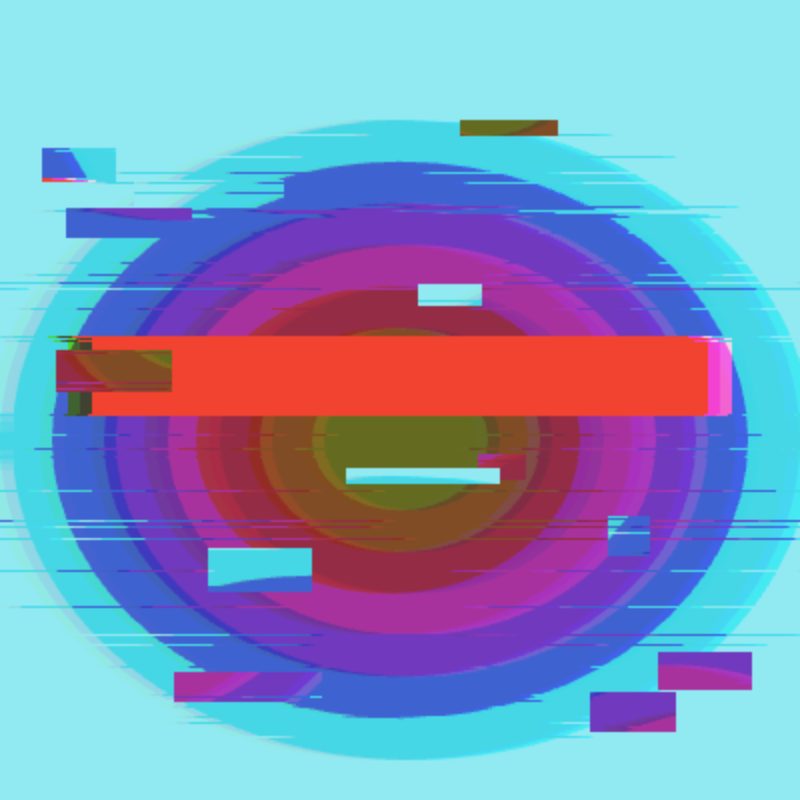
In one line Aesthetics built from deliberate data corruption and misreading — pixel displacement, channel separation, JPEG block artefacts, and datamoshing of video compression.
The code
The actual sketch behind the demo above — sandboxed and reproducible. This is the whole thing.
glitch-artifacts/index.html
const SEED = Math.floor(Math.random()*1e9);

// Build a clean geometric source image, then apply datamosh-style glitches:
// horizontal row displacement, RGB channel split, and block scrambling.
const RES = 400;

function setup() {
  randomSeed(SEED); noiseSeed(SEED);
  const s = Math.min(windowWidth, windowHeight);
  pixelDensity(1);
  const cnv = createCanvas(RES, RES);
  cnv.elt.style.width = s + 'px';
  cnv.elt.style.height = s + 'px';
  colorMode(HSB, 360, 100, 100);

  // source: bold concentric / stripe composition
  const baseHue = random(360);
  noStroke();
  background(baseHue, 40, 95);
  for (let i = 0; i < 7; i++) {
    fill((baseHue + i*40)%360, 70, 90 - i*8);
    const r = RES * (1 - i*0.13);
    ellipse(RES*0.5, RES*0.55, r, r*0.8);
  }
  fill((baseHue+180)%360, 80, 95);
  rect(RES*0.1, RES*0.42, RES*0.8, RES*0.1);

  loadPixels();
  const src = pixels.slice();
  const W = RES;

  // 1) row displacement in horizontal bands
  for (let y = 0; y < RES; y++) {
    if (random() < 0.12) {
      const shift = Math.floor(random(-40, 40));
      for (let x = 0; x < W; x++) {
        const sx = (x + shift + W) % W;
        const d = 4*(y*W+x), srci = 4*(y*W+sx);
        pixels[d]=src[srci]; pixels[d+1]=src[srci+1]; pixels[d+2]=src[srci+2];
      }
    }
  }
  // 2) RGB channel split (shift red left, blue right)
  const cur = pixels.slice();
  for (let y = 0; y < RES; y++)
    for (let x = 0; x < W; x++) {
      const d = 4*(y*W+x);
      const rx = Math.max(0, x-6), bx = Math.min(W-1, x+6);
      pixels[d]   = cur[4*(y*W+rx)];
      pixels[d+2] = cur[4*(y*W+bx)+2];
    }
  // 3) a few scrambled blocks
  const cur2 = pixels.slice();
  for (let k = 0; k < 14; k++) {
    const bw = Math.floor(random(20, 80)), bh = Math.floor(random(6, 24));
    const sx = Math.floor(random(W-bw)), sy = Math.floor(random(RES-bh));
    const dx = Math.floor(random(W-bw)), dy = Math.floor(random(RES-bh));
    for (let y = 0; y < bh; y++)
      for (let x = 0; x < bw; x++) {
        const di = 4*((dy+y)*W+(dx+x)), si = 4*((sy+y)*W+(sx+x));
        pixels[di]=cur2[si]; pixels[di+1]=cur2[si+1]; pixels[di+2]=cur2[si+2];
      }
  }
  updatePixels();
}How it works
Glitch art controls error rather than avoiding it. Common methods: 1. Databending: edit the raw bytes of an encoded file (sort, shift or splice them) and let the decoder misinterpret them — the format's own structure shapes the artefacts. 2. Channel/displacement effects: shift the R/G/B planes apart, or offset rows and blocks by a noise field, for tearing and chromatic-aberration looks. 3. Compression abuse: re-save at low JPEG quality to expose 8×8 DCT blocks, or "datamosh" video by deleting I-frames so P-frame motion vectors smear one scene's pixels over another. The craft is in dosing and masking the corruption so it reads as intentional texture, not noise.
Parameters
channelShift: number — Per-channel RGB offset producing colour fringing.blockSize: number — Size of the displaced/corrupted blocks.corruption: number — Amount of data the effect scrambles.scanlineGap: number — Spacing of the scanline disturbance.
Lineage
Frequently combined with
- Fragment Shader (GLSL) · 10 works
- Perlin / Simplex Noise · 7 works
- HSL / Hue Cycle · 6 works
- Particle System · 3 works
- Domain Warping · 2 works
- Delaunay Triangulation · 2 works
- Instanced Geometry · 2 works
- 3D Mesh / Geometry · 2 works
- Plotter-style Hatching · 2 works
- Bezier / Catmull-Rom Splines · 2 works
- Audio-Reactive · 2 works
- Voronoi Diagram · 1 work
Works using this algorithm (26)


Last updated 2026-07-16