Schotter
Georg Nees · 1968
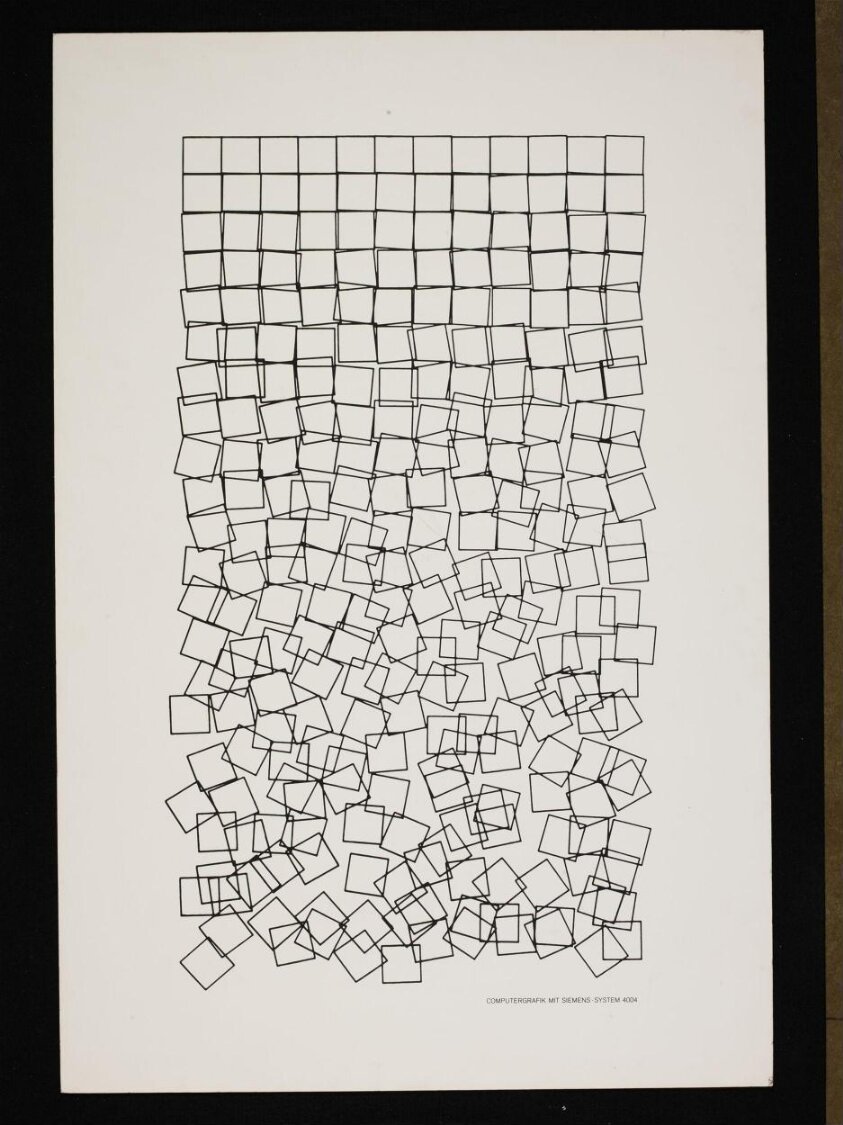
One of the iconic early works of generative art, by Georg Nees of the Stuttgart School. A regular grid of squares is drawn from the top of the page downward while a program introduces progressively larger pseudo-random rotations and displacements, so an ordered grid dissolves into disorder — a direct visual statement of controlled chance, or "order and disorder". Computed at Siemens and plotted on a Zuse Graphomat Z64 drawing machine. Nees — whose February 1965 Stuttgart show was among the first exhibitions of computer-generated art — is a founding figure of the Stuttgart School.
How it works
A raster of squares — 12 columns by 22 rows — in which each square is given a random rotation and displacement whose magnitude grows with the row, so an ordered lattice at the top dissolves into "gravel" at the bottom.
The plot is a grid of squares — 12 across, 22 down — drawn from the top of the sheet downward. Every cell holds one square, but before it is drawn two pseudo-random perturbations are applied whose MAGNITUDE is tied to how far down the grid the row sits: near-zero at the top, largest at the bottom. (1) Rotation — the square is turned by a random angle drawn from a range that widens with the row index. (2) Displacement — its centre is nudged by a random (dx, dy) offset whose range likewise grows with depth. Because the amount of disorder is a function of vertical position, the upper rows stay aligned and grid-like while the lower rows tumble into an ever more chaotic scatter, like settling gravel — the work's title. Nees computed the coordinates at Siemens and drew them on a Zuse Graphomat Z64 flatbed pen plotter, so every edge is a real drawn stroke, not a pixel. Conceptually it is a textbook demonstration of Max Bense's "generative aesthetics": a deterministic order deliberately modulated by bounded chance. Nees's published account does not fix the exact random ranges, so the pseudocode and live demo here are a faithful reconstruction of the documented mechanism, not his precise constants.
Algorithms
- Geometric / Hexagonal Tiling primary · classification: human-reviewed
Details
Sources
- Collection collections.vam.ac.uk ↗ — Victoria and Albert Museum, London — lithograph after the computer graphic, museum no. E.217-2008 (given by the Computer Arts Society).
- Collection spalterdigital.com ↗ — The Anne + Michael Spalter Digital Art Collection — 'Schotter (Gravel Stones)'.
Texts
Referenced by
- Why Love Generative Art? · 2018
Related works (by shared algorithms)


Last updated 2026-07-16