Schotter
Georg Nees · 1968
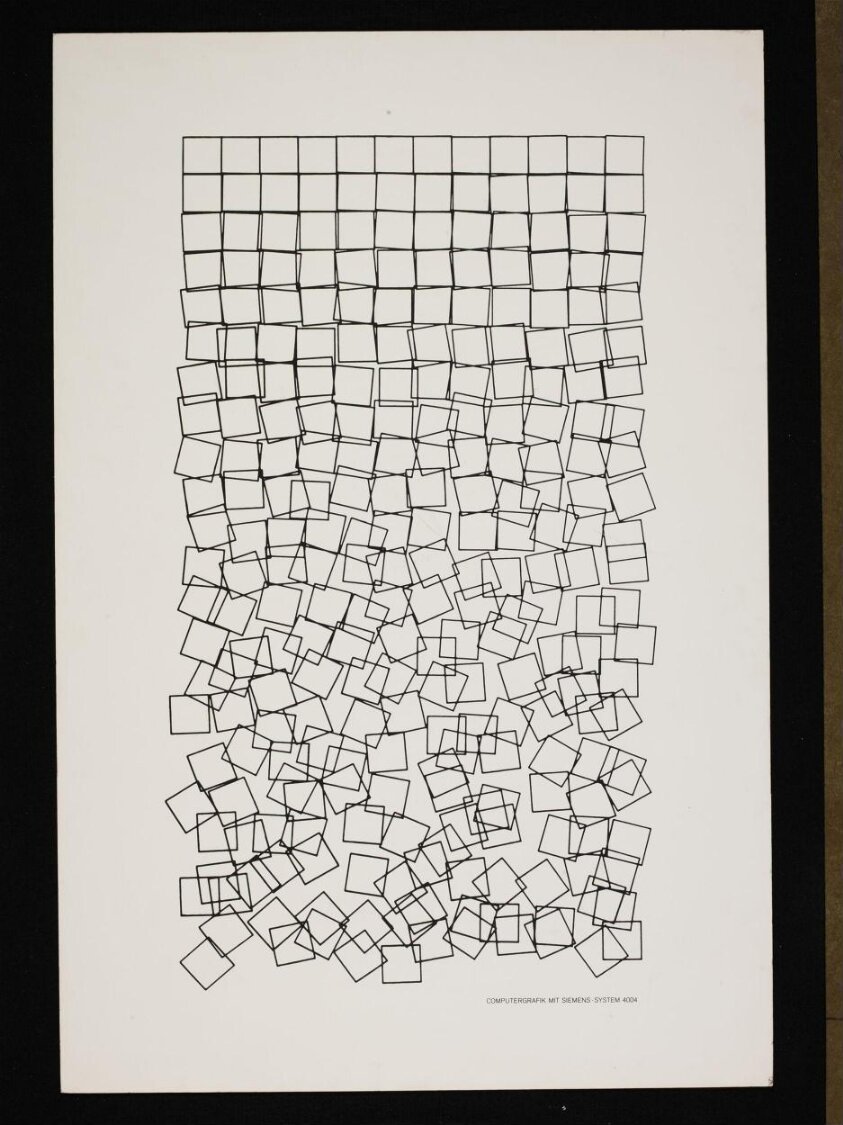
One of the iconic early works of generative art, by Georg Nees of the Stuttgart School. A regular grid of squares is drawn from the top of the page downward while a program introduces progressively larger pseudo-random rotations and displacements, so an ordered grid dissolves into disorder — a direct visual statement of controlled chance, or "order and disorder". Computed at Siemens and plotted on a Zuse Graphomat Z64 drawing machine. Nees — whose February 1965 Stuttgart show was among the first exhibitions of computer-generated art — is a founding figure of the Stuttgart School.
仕組み
12列×22行の正方形のラスター。各正方形に、行が下がるほど大きくなる乱数の回転と変位を 与えることで、上部の整然とした格子が下部で「砂利」へと崩れていく。
作品は正方形の格子——横12・縦22——で、紙の上端から下へと描かれる。各セルには正方形が 1つ入るが、描く前に2つの擬似乱数による摂動が加えられ、その大きさは行が格子のどれだけ 下にあるかに結び付く——上端でほぼ0、下端で最大になる。(1) 回転——正方形は、行番号とともに 範囲が広がる乱数の角度だけ回される。(2) 変位——その中心は、同様に下へ行くほど範囲が 広がる乱数の (dx, dy) だけずらされる。無秩序の量が垂直位置の関数であるため、上の行は 整列した格子のままで、下の行は次第に混沌とした散乱——沈む砂利、すなわち作品名——へと 転げ落ちる。ニースは座標をジーメンスで計算し、ツーゼ・グラフォマート Z64 フラットベッド ペンプロッタで描いた。ゆえに各辺は画素ではなく実際に引かれた線である。概念的には、 マックス・ベンゼの「生成美学」——決定論的な秩序を、限界づけられた偶然で意図的に変調する—— の教科書的な実演である。ニースの公表資料は正確な乱数範囲を定めていないため、ここでの 擬似コードとライブデモは、彼の厳密な定数ではなく、記録された仕組みの忠実な再構成である。
アルゴリズム
- Geometric / Hexagonal Tiling 主 · 分類: human-reviewed
詳細
出典
- Collection collections.vam.ac.uk ↗ — Victoria and Albert Museum, London — lithograph after the computer graphic, museum no. E.217-2008 (given by the Computer Arts Society).
- Collection spalterdigital.com ↗ — The Anne + Michael Spalter Digital Art Collection — 'Schotter (Gravel Stones)'.
文献
参照している文献
- なぜジェネレーティブアートを愛するのか · 2018
関連作品 (共有するアルゴリズムによる)


最終更新 2026-07-16