CUBE 4
Hans Dehlinger · 1987
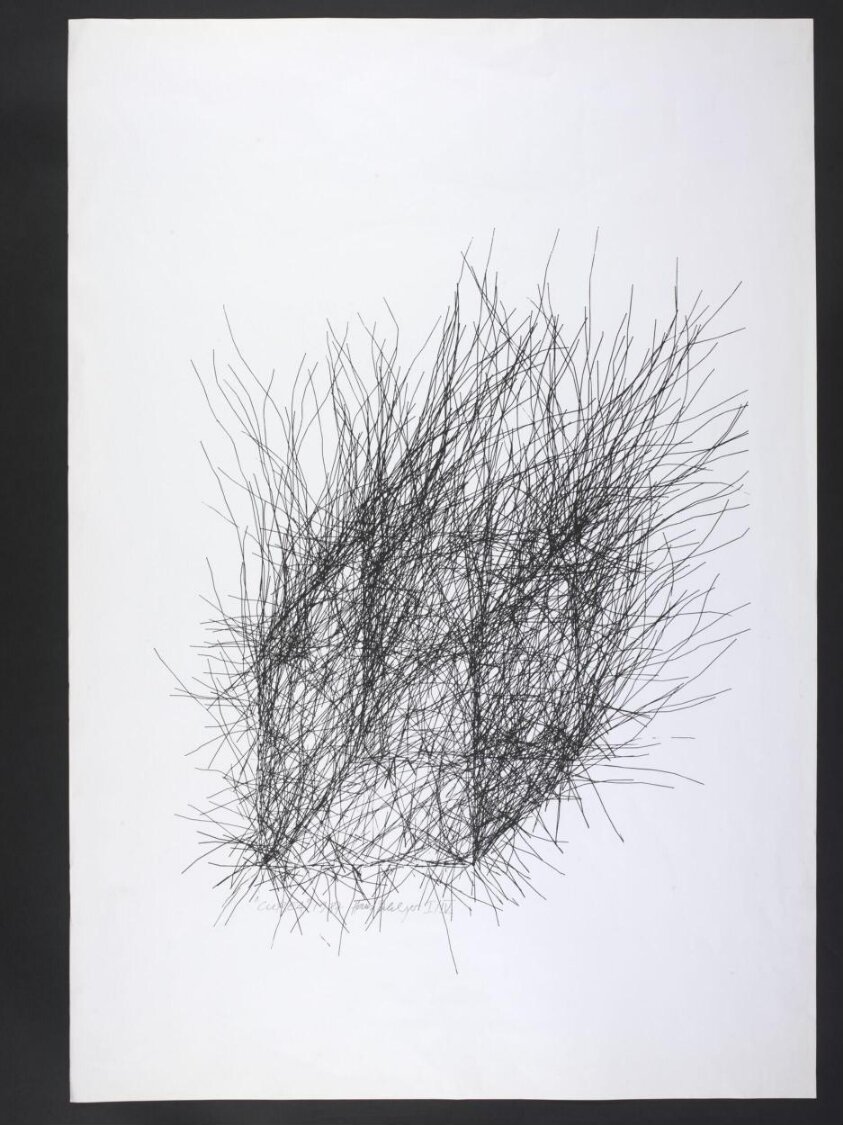
A black-and-white work from Hans Dehlinger's early "cube" series, generated algorithmically with his own software and plotted on a small pen plotter, then realised as a silkscreen print. Densely overlaid straight strokes build a digitally manipulated cube — exemplifying his lifelong subject, the computed line. Held by the V&A (E.946-2008) and first exhibited at the SIGGRAPH 1989 Art Show.
How it works
A cube drawn not as outlines but as accumulations: the program computes each straight pen stroke individually, repeating every edge with small perturbations until sharp lines pile into a dense, vibrating body.
Dehlinger — an architect by training who turned to algorithmic drawing in the 1980s — wrote his own programs in BASIC on a Tektronix machine at the University of Kassel's computer centre, outputting to a small A3 pen plotter; the 1986/87 cube series, of which this is the fourth, was made on that set-up. The method inverts the usual economy of the plotter: instead of one clean outline per edge, the program computes each straight stroke individually and lays down MANY passes per edge, each displaced by small random amounts. Because every stroke is razor-sharp but none coincide, the accumulated bundle reads at distance as a soft, dense, almost trembling line — his signature effect of "an unsharp impression from sharp lines" — while the underlying cube geometry (projected, and digitally manipulated across the series) still governs the whole. The plotter drawing was then realised as a silkscreen print; CUBE 4 was Dehlinger's first SIGGRAPH contribution (1989) and is held by the V&A. Per-work densities and perturbation amplitudes are not published, so the live demo reconstructs the documented mechanism — many individually computed, perturbed strokes per cube edge — rather than CUBE 4's exact parameters.
Algorithms
- Plotter-style Hatching primary · classification: human-reviewed
Details
Sources
- Collection collections.vam.ac.uk ↗ — Victoria & Albert Museum — accession E.946-2008 (silkscreen print from a computer-generated pen-plotter drawing).
- Web history.siggraph.org ↗ — SIGGRAPH History — “Cube 4”, SIGGRAPH 1989 Art Show.
Related works (by shared algorithms)


Last updated 2026-07-16