Boids / Flocking
First appeared 1986 · Craig Reynolds — Craig Reynolds, flocking model (1986/1987). · timeline ↗
inventor-coined Name · coined by Craig Reynolds (1987) — Reynolds coined "boids" himself, introducing it in the 1987 SIGGRAPH paper "Flocks, Herds, and Schools: A Distributed Behavioral Model" ("I called the generic simulated flocking creatures boids"). Commonly glossed as a contraction of "bird-oid object". Inventor-coinage.
In one line An agent-based model of flocking in which each "boid" steers by three local rules — separation, alignment and cohesion — applied only to nearby neighbours, so coordinated group motion emerges with no central control.
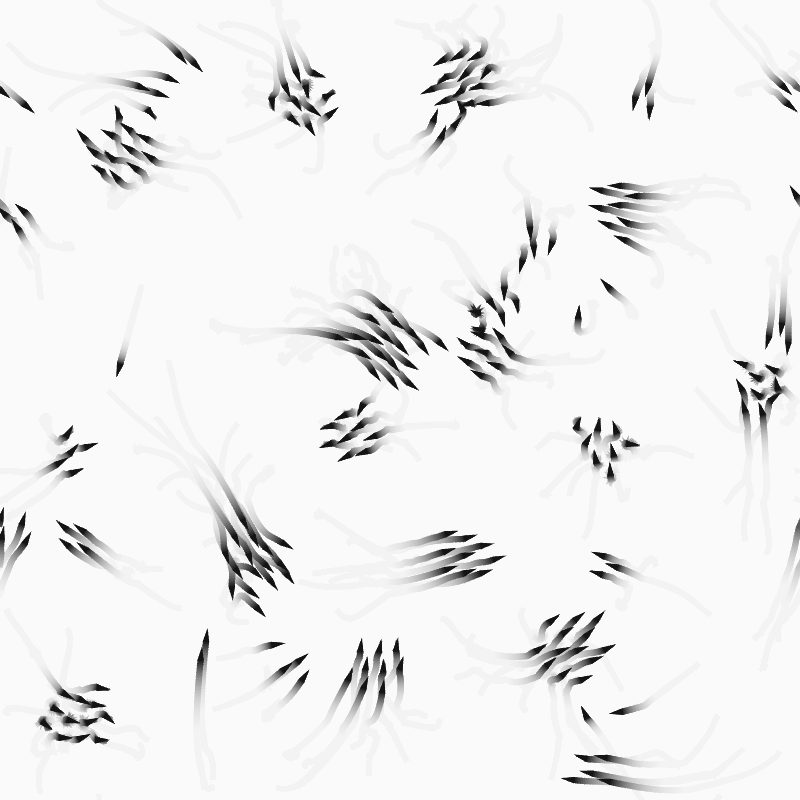
The code
The actual sketch behind the demo above — sandboxed and reproducible. This is the whole thing.
boids/index.html
const SEED = Math.floor(Math.random()*1e9);

let boids = [];
let s;

function setup() {
  randomSeed(SEED);
  s = Math.min(windowWidth, windowHeight);
  createCanvas(s, s);

  // Craig Reynolds' three rules: separation, alignment, cohesion.
  for (let i = 0; i < 220; i++) {
    boids.push({
      x: random(width), y: random(height),
      vx: random(-1, 1), vy: random(-1, 1),
    });
  }
  noStroke();
}

function draw() {
  background(250, 18);
  const VIEW = s * 0.07;
  const SEP  = s * 0.022;
  const MAX_SPEED = s * 0.0045;

  for (const b of boids) {
    let cx = 0, cy = 0, vx = 0, vy = 0, sx = 0, sy = 0, n = 0;
    for (const o of boids) {
      if (o === b) continue;
      const dx = o.x - b.x, dy = o.y - b.y;
      const d2 = dx * dx + dy * dy;
      if (d2 > VIEW * VIEW) continue;
      n++;
      cx += o.x; cy += o.y;
      vx += o.vx; vy += o.vy;
      if (d2 < SEP * SEP) {
        const d = Math.sqrt(d2) + 1e-4;
        sx -= dx / d; sy -= dy / d;
      }
    }
    if (n > 0) {
      cx /= n; cy /= n; vx /= n; vy /= n;
      // cohesion
      b.vx += (cx - b.x) * 0.0008;
      b.vy += (cy - b.y) * 0.0008;
      // alignment
      b.vx += (vx - b.vx) * 0.04;
      b.vy += (vy - b.vy) * 0.04;
      // separation
      b.vx += sx * 0.08;
      b.vy += sy * 0.08;
    }
    // limit speed
    const sp = Math.hypot(b.vx, b.vy);
    if (sp > MAX_SPEED) { b.vx = b.vx / sp * MAX_SPEED; b.vy = b.vy / sp * MAX_SPEED; }
    b.x += b.vx; b.y += b.vy;
    // wrap
    if (b.x < 0) b.x += width; if (b.x >= width)  b.x -= width;
    if (b.y < 0) b.y += height; if (b.y >= height) b.y -= height;

    // draw as a tiny triangle pointing along velocity
    const a = Math.atan2(b.vy, b.vx);
    const L = s * 0.012;
    fill(20);
    const px = b.x, py = b.y;
    const c = Math.cos(a), si = Math.sin(a);
    triangle(
      px + c * L,         py + si * L,
      px - c * L*0.5 - si*L*0.35, py - si * L*0.5 + c*L*0.35,
      px - c * L*0.5 + si*L*0.35, py - si * L*0.5 - c*L*0.35,
    );
  }
}How it works
Give every boid a position and velocity. Each step, for each boid, find the neighbours within a perception radius and compute three steering vectors: 1. Separation: steer away from neighbours that are too close (avoid crowding). 2. Alignment: steer toward the average heading of neighbours. 3. Cohesion: steer toward the average position (centre of mass) of neighbours. Sum the three (often weighted), add it to the velocity, clamp to a maximum speed, and move. The flock-like behaviour is purely emergent from these local interactions; extra rules (goal-seeking, obstacle/predator avoidance) are layered on the same way.
Parameters
separation: number — Weight of the steering force that avoids crowding nearby flockmates.alignment: number — Weight of the force that matches velocity with neighbours.cohesion: number — Weight of the force that steers toward the local centre of mass.perceptionRadius: number — Distance within which other agents count as neighbours.maxSpeed: number — Upper bound on each agent’s velocity.
Lineage
Frequently combined with
- Perlin / Simplex Noise · 7 works
- Particle System · 4 works
- HSL / Hue Cycle · 3 works
- Quadtree / Recursive Quad Split · 3 works
- Spring-Mass / Verlet · 2 works
- Raymarching with SDFs · 2 works
- Fragment Shader (GLSL) · 2 works
- Plotter-style Hatching · 2 works
- Flow Field / Vector Field · 2 works
- Fractal / Recursive Subdivision · 2 works
- Voronoi Diagram · 1 work
- Marching Squares / Contours · 1 work
Works using this algorithm (11)


Last updated 2026-07-16