Walk-Through-Raster
Frieder Nake · 1966
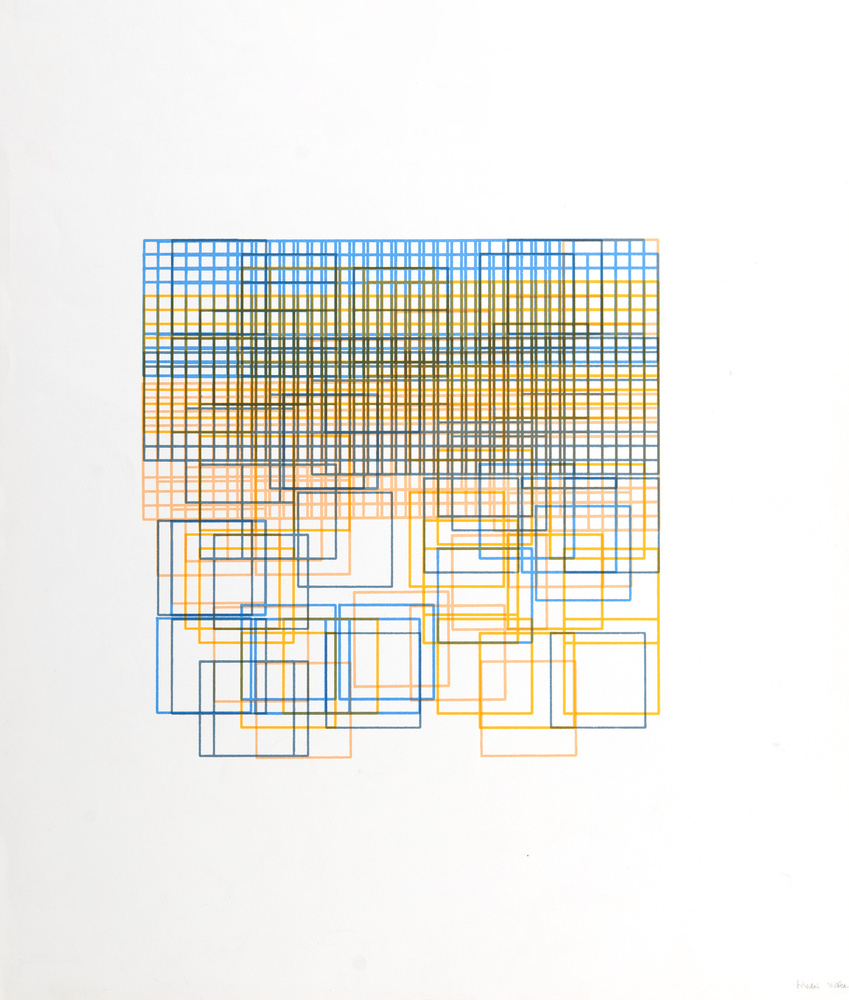
A 1966 series of pen-plotter drawings by Frieder Nake, a founding figure of the Stuttgart School of computer art. Driven by his 'Walk-Through-Raster' program (written in Algol 60), the work places a repertoire of signs onto the cells of a grid (a raster): one function selects a sign, and a second function chooses each following sign from the previous one according to a probability distribution — a Markov-chain process that generates a chain of signs, which is then mapped cell by cell across the picture plane. The deliberate use of random variables means the finished image could not be predicted before the plotter had drawn it. The graphics were computed on a Telefunken TR4 computer and output on the Zuse Graphomat Z64 drawing machine.
Details
Sources
- Collection zkm.de ↗ — ZKM | Center for Art and Media Karlsruhe — 'Walk-Through-Raster. Serie 7.3-1', Frieder Nake, 1966. Plotter drawing (ink on paper), computed on a Telefunken TR4 in Algol 60, output via the Zuse Graphomat Z64.
- Collection collections.vam.ac.uk ↗ — Victoria and Albert Museum, London — a photograph of a plotter sheet from Nake's 'Walk-Through-Raster' series (1966; the museum holds several individual sheets, some dated into early 1967), drawn on the Zuse Graphomat Z64.
Last updated 2026-07-16