SKEW D 1(C)
Mark Wilson · 1985
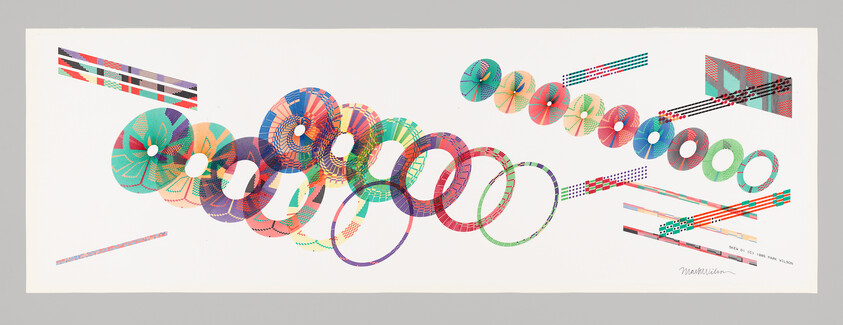
A long horizontal pen-plotter panel by Mark Wilson: software-generated overlapping circular rings and patterned discs in colour, drawn on a flatbed pen plotter from his own programs — an example of his "Algorithmic Expressionism".
How it works
From Wilson's Skew series: geometric primitives — here rings and patterned discs — are instanced and transformed in software of his own writing, then layered and drawn as coloured pen strokes by a plotter.
Wilson, an early adopter of the personal computer as an art tool (from 1980), wrote his own drawing software rather than using packages. By his own account of the Skew series ("Plotter Drawings 1981–1992"), the programs apply simple geometric transformations in three dimensions to fields of primitives, and the interest of each sheet comes from how the transformed, overlapping instances interfere — a "quasi-architectural" layered space. In this 1985 panel, catalogued by the Whitney, the primitive vocabulary is circular: concentric rings and discs filled with pen patterns, instanced across a long horizontal field so their overlaps weave dense colour interference. Every mark is a physical pen stroke on a flatbed plotter — the machine draws what the program composed, in the manner Wilson called Algorithmic Expressionism. Wilson's exact per-work parameters are not published; this describes the documented working method of the series (as with the sibling Skew A, 1983, in the SIGGRAPH archives, made with artist-written software on an IBM PC and a Tektronix 4663 plotter).
Details
Sources
- Collection whitney.org ↗ — Whitney Museum of American Art — accession 2023.157 (plotter pen and ink on paper).
Last updated 2026-07-16