Random War
Charles Csuri · 1967
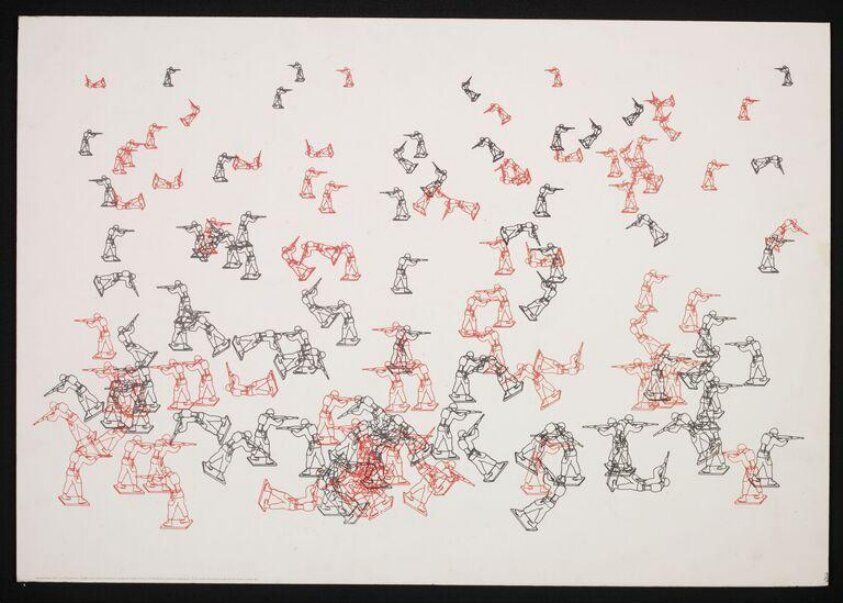
A landmark early computer artwork by Charles Csuri with programmer James Shaffer, in which a random-number generator on an IBM 7094 placed and rotated hundreds of identical toy-soldier figures across a battlefield, assigning each a name, rank, and fate — dead, wounded, missing, or surviving. Output via a drum pen-plotter and later issued as a lithograph, it is an early example of generative art used as anti-war commentary, held in collections including the V&A and ZKM.
How it works
One toy-soldier figure, stamped hundreds of times at random positions and angles across a field, each soldier assigned a random name, rank and fate — the randomness of a computer standing in for the randomness of war.
Random War turns a random-number generator into a battle. Csuri and programmer James Shaffer took a SINGLE drawn figure — a toy soldier — and had the program instance it many hundreds of times. For each copy the generator draws random numbers that set its POSITION and ORIENTATION on the field, so the same figure scatters into an army with no two soldiers alike in placement. The conceptual step is that the same randomness also assigns each soldier a NAME, a RANK, and a FATE — surviving, wounded, missing, or dead — tallied into the two opposing sides. Nothing is composed by hand: who lives and who dies is decided by the machine''s indifferent draw, which is exactly the point of the piece as anti-war statement — the arbitrariness of casualty as a probability table. The coordinates and states were computed on an IBM 7094 and drawn by a CalComp drum pen-plotter, later issued as a lithograph. The live demo enacts the core — one soldier glyph, stamped at random positions and angles, each coloured by a randomly drawn fate; the specific figure and the fate proportions are a stand-in, not Csuri''s own.
Details
Sources
- Collection collections.vam.ac.uk ↗ — Victoria & Albert Museum, London — accession E.124-2008 (lithograph after the 1967 plotter drawing).
- Web history.siggraph.org ↗ — ACM SIGGRAPH History Archives record (also held at ZKM; OSU Csuri Project).
Last updated 2026-07-16