Oscillon 40
Ben F. Laposky · 1952
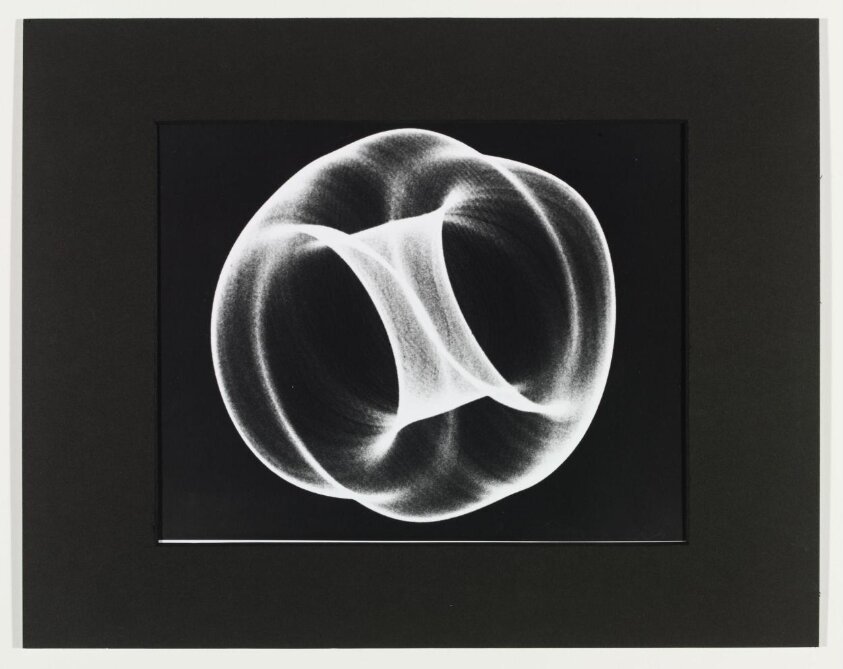
One of Ben Laposky's signature "Oscillons" — a photograph capturing abstract waveform patterns produced by manipulating electronic signals on a cathode-ray oscilloscope screen, recorded by long exposure since the moving traces could not otherwise be fixed. It is among the earliest works of electronic art and the earliest item in the Victoria & Albert Museum's computer-art collection.
How it works
Not a program but an analog procedure: two banks of electronic oscillators drive the horizontal and vertical deflection of an oscilloscope; the moving spot traces a standing waveform figure, fixed by a long-exposure photograph.
Oscillon 40 predates digital computers, so there is no code — but there is a precise generative procedure. An oscilloscope draws a point whose horizontal (X) and vertical (Y) positions are each set by an input voltage. Laposky fed X and Y from separate electronic sine-wave oscillators and combined several of them, adjusting frequency, amplitude and phase by hand. When X and Y are sinusoids, the spot traces a Lissajous figure; when their frequencies stand in near-integer ratios and are slightly detuned, the figure slowly precesses and, layered over time, fills out into the dense, symmetrical rosette that is the "oscillon". Because the trace is light in continuous motion and cannot be held on the screen, the work IS the long-exposure photograph that accumulates the whole figure (sometimes through colour filters). The maths is identical to a harmonograph, which is what the live demo here uses — X and Y as sums of slowly decaying sinusoids — a digital simulation of the analog set-up, not a copy of the artwork; Laposky's exact oscillator settings are not published, so the demo's constants are a plausible reconstruction.
Details
Sources
- Collection collections.vam.ac.uk ↗ — Victoria & Albert Museum, London — museum no. E.958-2008 (the earliest item in the V&A's computer-art holdings).
- Web history.siggraph.org ↗ — ACM SIGGRAPH History Archives — Oscillon 40, 1952, photograph of analog oscilloscope screen, 11×14in.
Last updated 2026-07-16