Markov-chain Figure, Color
Hiroshi Kawano · 1964
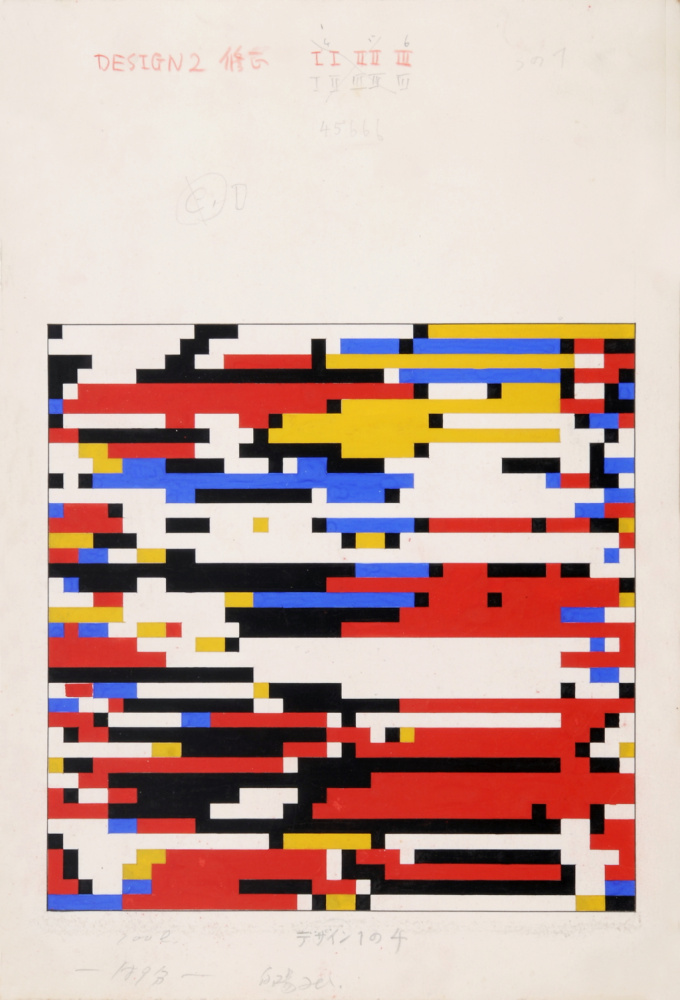
An early Japanese computer-art work by the philosopher-aesthetician Hiroshi Kawano (1925-2012), among the first computer-generated images made in Japan. Working at the University of Tokyo's computer centre, Kawano programmed a Markov-chain (Markov-process) procedure on an OKITAC 5090A computer using the OKISIP macro assembler: a transition-probability matrix derived from a source pattern drives a Monte-Carlo synthesis that lays out a grid of coloured cells, yielding a Mondrian-like coloured field. Because the line printers of the period could not print in colour, the machine produced a monochrome layout that Kawano then coloured by hand in gouache on paper. The canonical surviving instance, ZKM's "Design 3-1. Data 4, 5, 6, 6, 6" (1964, 33.2 x 23 cm), is described as a second-order colour Markov chain; the data string names the colour symbols used. There is no pen-plotter or deterministic reproducible seed in the modern sense, so the generative provenance is recorded as none.
How it works
A grid of coloured cells generated by a Markov chain: each cell's colour is sampled from a transition-probability matrix conditioned on the preceding cell(s), so local colour dependencies build a Mondrian-like field.
Kawano's method is a Markov process over a grid. First he builds a TRANSITION-PROBABILITY MATRIX: for each possible colour state, the probabilities of which colour comes next. Kawano derived those probabilities by ANALYSING a source pattern (for the "artificial Mondrian" work, the statistics of a Mondrian-like composition), so the machine inherits the source's local colour habits without copying it. Then he SYNTHESISES a new picture by Monte-Carlo sampling: starting from a cell, the colour of the next cell is drawn at random according to the row of the matrix for the current state, and this repeats across the grid so each choice depends on what came before. The canonical surviving piece is a SECOND-order chain — the next colour depends on the previous TWO cells — which captures longer runs and richer structure than a first-order chain. It ran on the University of Tokyo's OKITAC 5090A in the OKISIP macro assembler; because the line printer could not print colour, the machine output a monochrome symbol layout that Kawano then painted by hand in gouache, the colour data string (e.g. "4, 5, 6, 6, 6") naming the symbols. The live demo reconstructs the mechanism with a simplified FIRST-order matrix over a small palette — enough to show how conditioned randomness yields structured colour, but not Kawano's exact second-order matrix, which was fitted to a specific source.
Details
Sources
- Collection zkm.de ↗ — ZKM | Center for Art and Media Karlsruhe — Hiroshi Kawano, "Design 3-1. Data 4, 5, 6, 6, 6" (1964), the canonical surviving instance of Kawano's colour Markov-chain figures. Medium recorded as "painting after computer-generated design; computer: OKITAC 5090A, programming language: OKISIP, gouache on paper", 33.2 x 23 cm. ZKM holds Kawano's works and archive (acquired 2010).
- Web isea2011.sabanciuniv.edu ↗ — Simone Gristwood, "Rediscovering Hiroshi Kawano — Japan's Pioneer of Computer Art", ISEA2011 (Istanbul). Documents Kawano's 1964 colour designs computed via a (second-order) Markov process on the University of Tokyo's OKITAC 5090A, output on a line printer in black and white and then coloured by hand.
- Publication ci.nii.ac.jp ↗ — Tama Art University Museum, exhibition catalogue "20-seiki konpyuta aato no kiseki to tenbo" (The Trajectory and Prospect of 20th-century Computer Art), 2006, which includes Kawano's early computer-art works. Secondary corroborating source (via CiNii).
Texts
- Hiroshi Kawano (1925–2012): Japan's Pioneer of Computer Arts
- Computers and Aesthetics: Exploring the Art of Artificial Intelligence (trans.)
Last updated 2026-07-16