Interruptions
Vera Molnár · 1969
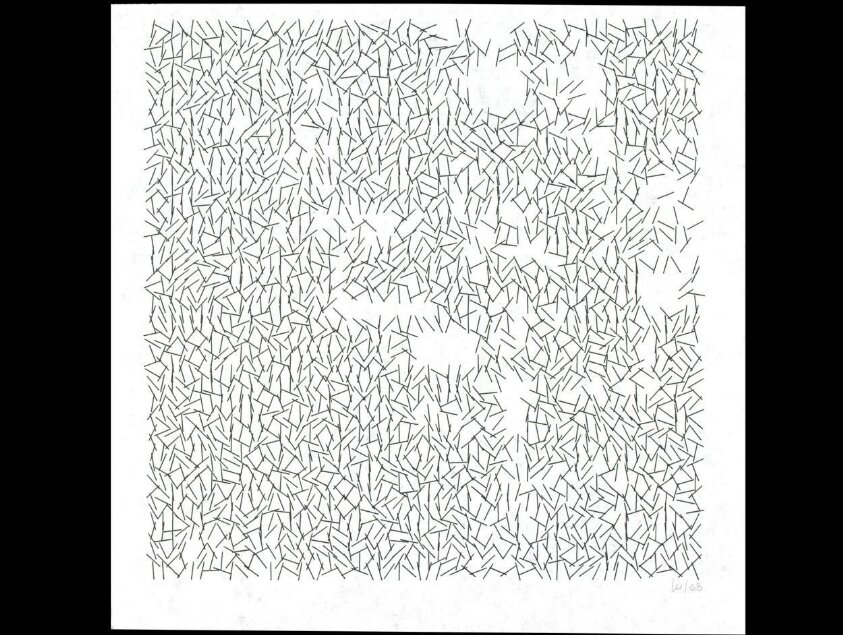
A landmark early computer drawing by Vera Molnár, plotted on a Benson pen plotter from a FORTRAN program: a regular grid of short line segments into which the program introduces controlled disorder — random rotations and "interruptions" (random voids where lines are erased). One of the first works by a woman to enter the V&A's computational-art holdings.
How it works
A regular grid in which every cell holds one short straight line segment turned to a uniformly random angle; the program then randomly withholds some cells, opening the voids — the "interruptions" — that give the work its name.
Start from a regular square grid. In each cell, draw a single short line segment centred on the cell and rotated by a random angle. Unlike Nees's Schotter, the disorder here is UNIFORM — the rotation is drawn from the same range everywhere, with no top-to-bottom gradient — so at first the field reads as an even, shimmering texture of tilted strokes. The decisive second step is subtractive: the program randomly withholds a fraction of the cells, leaving them blank. Those empty patches are the "interruptions" — voids that break the otherwise continuous weave and let figure emerge from an all-over ground. Molnár taught herself FORTRAN at a Sorbonne research lab in 1968 and drew the output on a Benson pen plotter, so every stroke is a real drawn line. The piece embodies her idea of the "machine imaginaire": a controlled system whose bounded randomness she used to search for compositions the unaided eye would not find. Her exact grid size, segment length and erasure rate are not fixed in the published accounts, so the pseudocode and live demo here reconstruct the documented mechanism rather than her precise parameters.
Algorithms
- Geometric / Hexagonal Tiling primary · classification: human-reviewed
Details
Sources
- Collection collections.vam.ac.uk ↗ — Victoria and Albert Museum, London — accession E.269-2011.
- Collection themorgan.org ↗ — The Morgan Library & Museum, New York — accession 2017.353 (Benson plotter, black ink on paper).
Texts
Related works (by shared algorithms)


Last updated 2026-07-16