(Des)Ordres
Vera Molnár · 1974
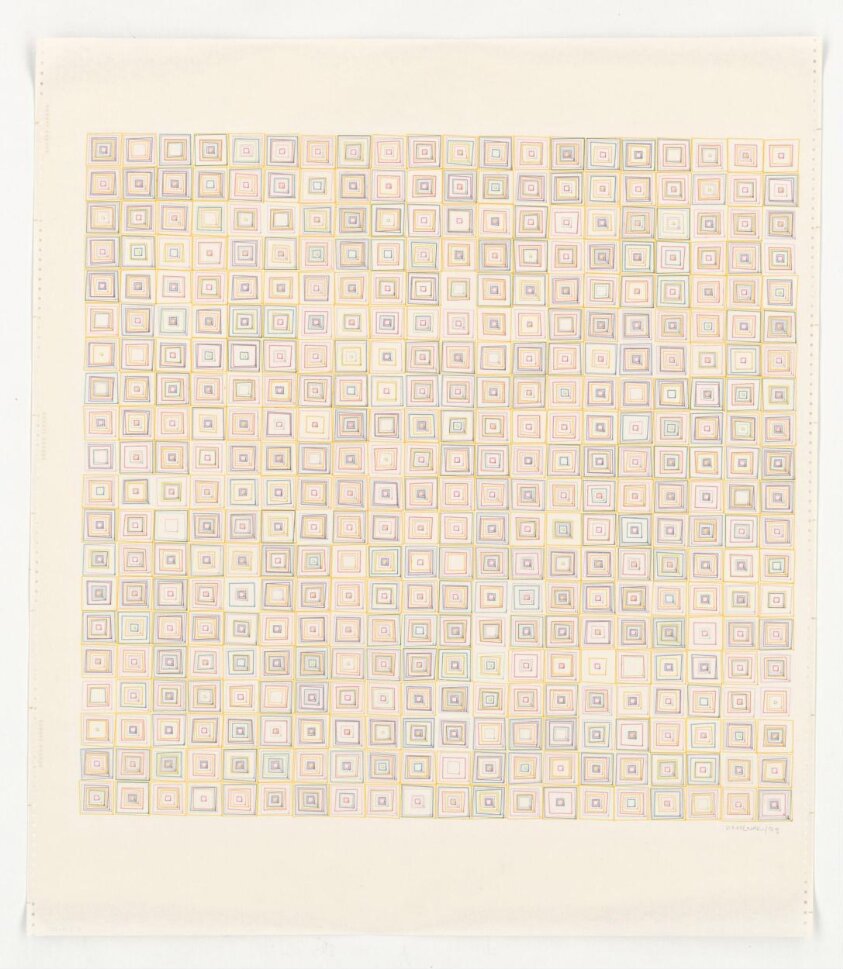
A plotter drawing by Vera Molnár from a custom program: a 20×20 grid of concentric coloured square frames whose algorithmic parameters are altered to randomly disrupt the regularity, producing a vibrating order/disorder. The title puns on French "désordres" (disorders) and "des ordres" (some orders).
How it works
A strict 20×20 grid, each cell holding nested concentric square frames; a program then randomly perturbs the frames' geometry in a controlled minority of places, so the lattice shivers between order and disorder — the pun of the title.
The base state is maximal order: a 20-by-20 grid whose every cell contains the same motif, a set of nested concentric square frames. The program — like Interruptions, written by Molnár for a Benson pen plotter — then injects controlled randomness into that motif: within chosen cells the frames' vertices are displaced, so the neat squares buckle into trembling quadrilaterals, while other cells stay nearly regular. Because the eye reads the intact grid as the rule, every perturbed cell registers as an event, and the sheet oscillates between "des ordres" (some orders) and "désordres" (disorders) — Molnár's stated subject, chance calibrated against a system. Compared with her 1969 Interruptions the vocabulary has advanced from single strokes to structured motifs, and the disorder is applied cell-by-cell rather than uniformly. The precise perturbation amplitudes and the fraction of disturbed cells are not published, so the live demo reconstructs the documented mechanism — concentric-frame grid, vertex jitter concentrated in a minority of cells — rather than her exact parameters.
Details
Sources
- Collection collections.vam.ac.uk ↗ — Victoria and Albert Museum, London — accession E.271-2011 (Benson plotter, colour ink on paper).
- Web dam.org ↗ — Digital Art Museum (DAM) — '(Des)Ordres', 1974, Benson plotter; the word-play title (désordres / des ordres) and the concentric-squares disorder algorithm.
Last updated 2026-07-16