Chance and Order Group VIII, Drawing 6
Kenneth Martin · 1971
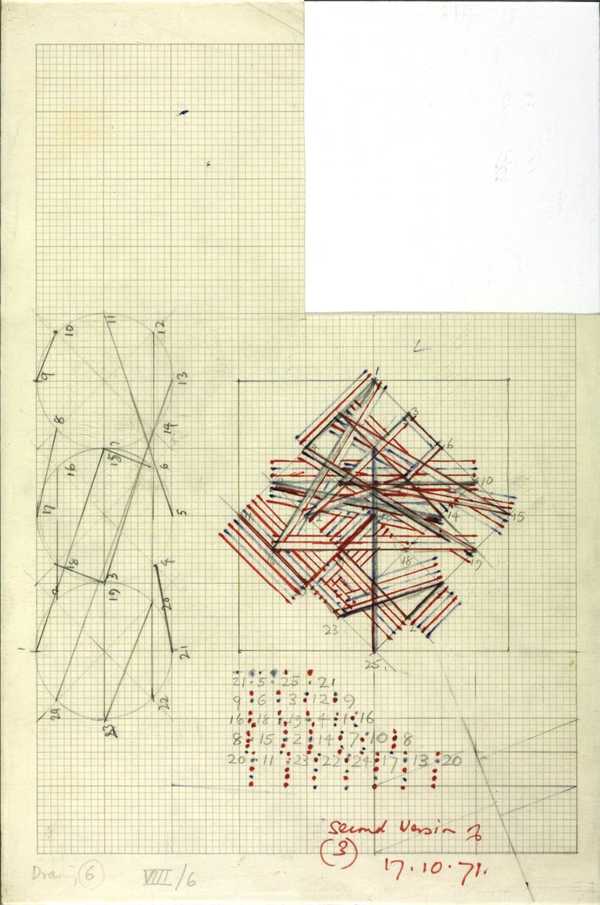
A chance-determined drawing from Martin's Chance and Order series: he numbered the points of intersection on a grid of squares, wrote the numbers on small cards and drew them at random, then made a line between each successive pair of numbers as they were picked — so the composition is produced by a chance-driven procedure rather than free composition. Here the drawing is restricted to a square set on its point within a four-by-four grid. Held by Tate.
How it works
Number the intersection points of a grid, draw the numbers two at a time at random, and connect each drawn pair with a line in the order they come up — a composition produced by chance under a fixed rule, not by free choice.
Martin built a hand procedure that is, in every meaningful sense, an algorithm with an explicit random seed. (1) Rule the surface as a grid of squares and NUMBER the points where the lines cross. (2) Write each number on a small card and shuffle the pack — this is the CHANCE input; drawing the cards is exactly sampling a random permutation of the points. (3) Turn the cards two at a time and, for each successive pair, draw a straight LINE between those two numbered points. Doing this for the whole pack builds the linear configuration one connection at a time, in the order chance dealt them. (4) ORDER then enters as fixed, predetermined rules layered on top — the direction a line is given, or (in the painted "Change" works) a further systematic transformation of the configuration — so the artist sets the system and the constraints while the dice set the particular result. It is a pure early statement of "chance and order": the same rules with a different shuffle give a different drawing, exactly the seed-versus-program logic of computational generative art, done by hand a few years before the plotter pioneers. This drawing restricts the figure to a square set on its point within a four-by-four grid. The live demo runs the core — number, shuffle, connect successive pairs; Martin's specific ordering rules are a reconstruction.
Details
Sources
- Collection tate.org.uk ↗ — Tate (T01848) — graphite and ink on paper, 1971; chance-determined numbered-grid method.
- Collection moma.org ↗ — MoMA — Chance and Order I (1971), same series; corroborates artist, method and dating.
Last updated 2026-07-16