AARON
Harold Cohen · 1979
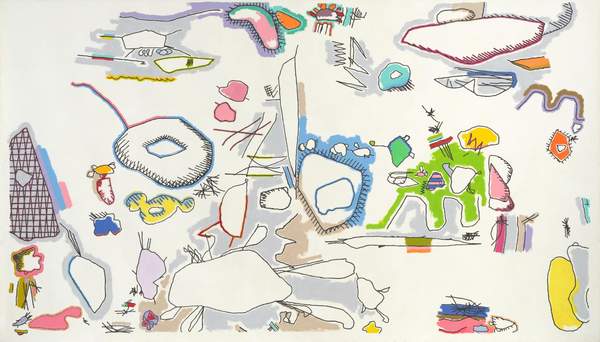
An autonomous line drawing produced by AARON, the rule-based AI program Harold Cohen began developing around 1972. Rather than executing a human-drawn design, AARON composes the image itself from an internal repertoire of forms and compositional rules (figure/ground, closure, spatial division); this 1979 work was drawn onto paper by Cohen's floor-crawling robotic "turtle".
How it works
A rule-based program that is not given a drawing but a body of knowledge about drawing — a small vocabulary of forms plus rules for composing and for making a convincing freehand line — from which, with random choices, it composes each picture itself.
AARON is dissected at the level of its RULES, not its source: it is a knowledge-based program, not a stored image. Cohen gave it (1) a small vocabulary of primitive forms — straight lines, open curves and closed figures — and (2) a body of rules about how drawings are built. To make a picture AARON plans a composition, dividing the surface and deciding where forms and empty space go, working (in Cohen's description) from the foreground back to the background, and reasoning with distinctions a person uses without thinking: figure versus ground, inside versus outside (closure), how the page is spatially divided. Those formal rules are combined with RANDOM choices, so the rules fix the character of a drawing while chance fixes the particular one — no two are alike. Crucially, AARON does not plot a pre-computed path: each line is produced by a simulation of FREEHAND drawing in which the line is grown step by step under feedback, the way a hand corrects itself, giving the marks their living, slightly irregular quality. Before 1980 — this 1979 drawing included — AARON was deliberately abstract: it modelled the internal cognition of mark-making, the "functional primitives" of images, and drew no recognisable objects (representational subjects came in the 1980s). The finished plan is sent as movements to a floor-crawling robotic "turtle" that draws on paper with a pen. Because AARON is a large evolving system whose source is not reproduced here, this is a description of its documented rule-level behaviour, not a re-implementation.
Details
Sources
- Collection tate.org.uk ↗ — Tate, accession T14348 (purchased 2015).
- Web computerhistory.org ↗ — Computer History Museum — 'Harold Cohen and AARON, a 40-Year Collaboration'; documents AARON's drawing 'turtle' and the 1979 SFMOMA show from which the early AARON drawings date.
Referenced by
- The Further Exploits of AARON, Painter · 1995
- What is an Image? · 1979
Last updated 2026-07-16