Diffusion-Limited Aggregation
First appeared 1981 · Thomas Witten, Leonard Sander — Diffusion-limited aggregation — Witten & Sander (1981). · timeline ↗
inventor-coined Name · coined by Thomas Witten, Leonard Sander (1981) — Descriptive name coined by its inventors: Witten & Sander titled their 1981 work "diffusion-limited aggregation".
In one line A growth process in which randomly walking particles stick on contact with a growing cluster, producing fractal, branching dendritic patterns (like frost, coral, or mineral deposits).
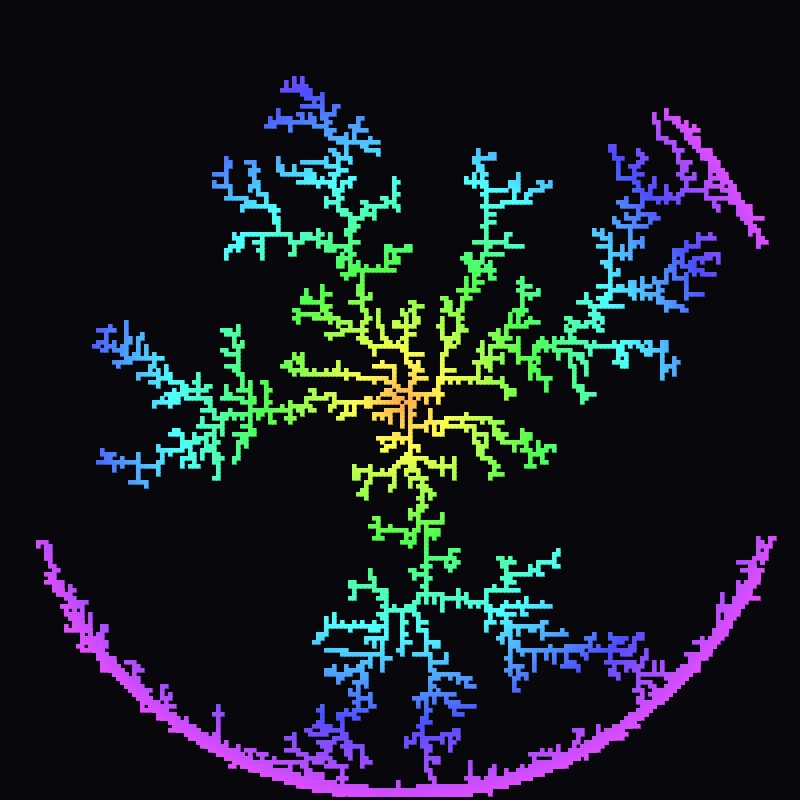
The code
The actual sketch behind the demo above — sandboxed and reproducible. This is the whole thing.
dla/index.html
const SEED = Math.floor(Math.random()*1e9);

// Diffusion-Limited Aggregation on a square lattice. A single seed sits at
// the centre; random walkers spawn on a circle just outside the cluster and
// stick the moment they touch it. The build accumulates frame by frame, so
// the canvas is never cleared after setup.
const G = 200;          // lattice resolution
const MAX = 8000;       // particles before stopping
let occ;                // occupancy grid (0 = empty)
let s, cell, cx, cy;
let R = 3;              // current cluster radius, in cells
let attached = 1;

function idx(x, y) { return y * G + x; }

function setup() {
  randomSeed(SEED);
  s = Math.min(windowWidth, windowHeight);
  createCanvas(s, s);
  background(8, 8, 12);
  pixelDensity(1);
  noStroke();
  colorMode(HSB, 360, 100, 100);

  cell = s / G;
  cx = G >> 1;
  cy = G >> 1;
  occ = new Uint8Array(G * G);
  occ[idx(cx, cy)] = 1;   // central seed
}

function draw() {
  const WALKERS = 300;
  for (let n = 0; n < WALKERS && attached < MAX; n++) {
    const spawnR = Math.min(G * 0.49, R + 5);
    const a = random(TWO_PI);
    let x = Math.round(cx + spawnR * Math.cos(a));
    let y = Math.round(cy + spawnR * Math.sin(a));
    const killR = spawnR + 8;
    const killR2 = killR * killR;

    for (let step = 0; step < 4000; step++) {
      const d = Math.floor(random(4));
      if (d === 0) x++; else if (d === 1) x--; else if (d === 2) y++; else y--;
      if (x < 1 || y < 1 || x >= G - 1 || y >= G - 1) break;   // off lattice

      const dx = x - cx, dy = y - cy;
      if (dx * dx + dy * dy > killR2) break;                    // wandered off

      if (occ[idx(x + 1, y)] || occ[idx(x - 1, y)] ||
          occ[idx(x, y + 1)] || occ[idx(x, y - 1)]) {
        occ[idx(x, y)] = 1;
        attached++;
        const r = Math.sqrt(dx * dx + dy * dy);
        if (r + 2 > R) R = r + 2;
        // hue ramps with distance from the seed: warm core → cool tips
        const t = Math.min(1, r / (G * 0.5));
        fill((30 + t * 260) % 360, 70, 100);
        rect(x * cell, y * cell, cell + 0.6, cell + 0.6);
        break;
      }
    }
  }
  if (attached >= MAX) noLoop();
}How it works
Start with one or more seed particles fixed as the cluster. Then repeat: 1. Release a particle from far away (often the edge of the domain or a circle around the cluster). 2. Let it random-walk (Brownian motion) step by step. 3. When it moves adjacent to (touches) any cluster particle, freeze it there — it becomes part of the cluster. 4. If it wanders too far, discard it and release a new one. Because tips of the cluster are reached first by incoming walkers, they shield the interior, so growth concentrates at extremities — yielding the characteristic self-similar, fractal dendrites (fractal dimension ≈ 1.71 in 2D).
Parameters
particleCount: number — Number of walkers released to aggregate onto the cluster.stepSize: number — Distance a walker moves per random-walk step.stickiness: number — Probability a walker sticks on contact with the existing cluster.seedCount: number — Number of fixed seed points the cluster grows from.
Lineage
Frequently combined with
- Particle System · 2 works
- Bezier / Catmull-Rom Splines · 1 work
- Geometric / Hexagonal Tiling · 1 work
- Flow Field / Vector Field · 1 work
Works using this algorithm (3)


Last updated 2026-07-16