Physarum (Slime-Mould Agents)
別名: slime mould、Physarum transport network、agent trail-following
初出 2010 · Jeff Jones — The widely-used computational model was formalized by Jeff Jones, "Characteristics of pattern formation and evolution in approximations of Physarum transport networks" (Artificial Life, MIT Press, 2010). · 年表 ↗
コミュニティ・通称 名称 — 記述的命名。粘菌 Physarum polycephalum の輸送ネットワークを近似することにちなむ (モデルは Jones 2010 が定式化)。人名エポニムではない。
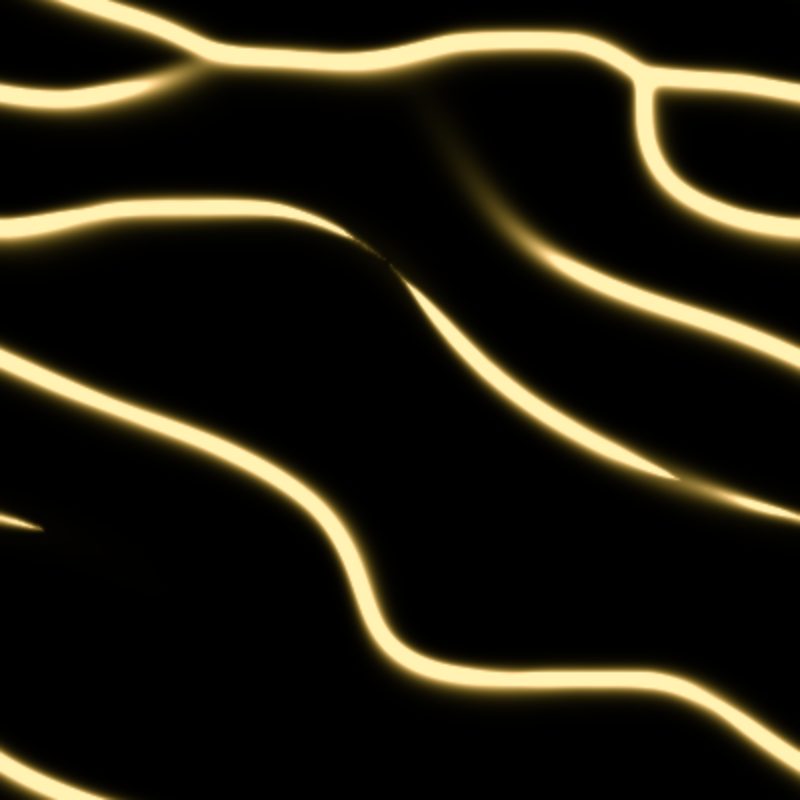
ひとことで 多数の単純なエージェント(粒子)が、共有された拡散するトレイル(誘引物質)マップを感知・追従し、そこへ物質を堆積させるエージェントベースのモデル。局所的な「感知・堆積・移動」の規則だけから、粘菌 Physarum polycephalum の採餌行動に似た葉脈状の動的な輸送網が自己組織化する。
コード
上のデモの実際のスケッチ(サンドボックスで再現可能)。これで全部です。
physarum/index.html
// Physarum (slime-mould) transport networks, after Jeff Jones' agent model
// (2010). Each of many agents senses the chemo-attractant trail at three points
// ahead (left / centre / right), steers toward the strongest, steps forward and
// deposits more trail. The trail field diffuses (blur) and decays every tick.
// Purely local sensing + reinforcement → emergent vein-like networks. Canvas 2D.
const SEED = (Math.random() * 1e9) | 0;
let rs = SEED >>> 0 || 1;
function rnd(){ rs ^= rs<<13; rs ^= rs>>>17; rs ^= rs<<5; rs >>>= 0; return rs / 4294967296; }

const cv = document.getElementById('c');
const ctx = cv.getContext('2d');
const DIM = Math.floor(Math.min(window.innerWidth, window.innerHeight));
const RES = Math.min(DIM, 400);   // higher res + small sensor ⇒ many channels (a fine mesh, not a few lines)
cv.width = cv.height = RES;
cv.style.width = cv.style.height = DIM + 'px';

// --- Jones parameters (the values that reliably reticulate) ---
const N        = Math.floor(RES * RES * 0.30);   // agent density
const SO       = 5;                              // sensor offset distance (px) — small vs the grid ⇒ fine mesh
const SA       = 22.5 * Math.PI / 180;           // sensor angle
const RA       = 22.5 * Math.PI / 180;           // rotation (turn) angle
const STEP     = 1.0;                            // move distance
const DEPOSIT  = 3.0;                            // trail dropped per step
const DECAY    = 0.96;                           // multiplicative decay after diffuse (higher ⇒ veins persist,
                                                 // so more of the network is visible at once)
const CAP      = 255;                            // trail saturation (bounds runaway feedback)
const DIFFUSE  = 0.35;                           // blur strength — light, so distinct veins survive
const NOISE    = 5 * Math.PI / 180;              // heading jitter/step — breaks the perfect alignment
                                                 // that otherwise locks agents into parallel bands

let trail = new Float32Array(RES * RES);
let buf   = new Float32Array(RES * RES);
const ax = new Float32Array(N), ay = new Float32Array(N), ah = new Float32Array(N);
for (let i = 0; i < N; i++) {
  ax[i] = rnd() * RES; ay[i] = rnd() * RES; ah[i] = rnd() * Math.PI * 2;   // uniform seeding
}

const wrap = (v) => (v % RES + RES) % RES;
function senseAt(x, y, a) {
  const sx = wrap(Math.round(x + Math.cos(a) * SO));
  const sy = wrap(Math.round(y + Math.sin(a) * SO));
  return trail[sy * RES + sx];
}

function agents() {
  for (let i = 0; i < N; i++) {
    const x = ax[i], y = ay[i], h = ah[i];
    const F  = senseAt(x, y, h);
    const FL = senseAt(x, y, h - SA);
    const FR = senseAt(x, y, h + SA);
    let nh = h;
    if (F > FL && F > FR) { /* strongest ahead → keep heading */ }
    else if (F < FL && F < FR) nh = h + (rnd() < 0.5 ? -RA : RA);   // valley ahead → random turn
    else if (FR > FL) nh = h + RA;                                  // steer right
    else if (FL > FR) nh = h - RA;                                  // steer left
    nh += (rnd() - 0.5) * 2 * NOISE;                                // small jitter
    const nx = wrap(x + Math.cos(nh) * STEP);
    const ny = wrap(y + Math.sin(nh) * STEP);
    ax[i] = nx; ay[i] = ny; ah[i] = nh;
    const di = (ny | 0) * RES + (nx | 0);
    trail[di] = Math.min(CAP, trail[di] + DEPOSIT);                 // deposit (saturating)
  }
}

function diffuseDecay() {
  for (let y = 0; y < RES; y++) {
    const y0 = ((y - 1 + RES) % RES) * RES, y1 = y * RES, y2 = ((y + 1) % RES) * RES;
    for (let x = 0; x < RES; x++) {
      const xl = (x - 1 + RES) % RES, xr = (x + 1) % RES;
      const s = trail[y0+xl]+trail[y0+x]+trail[y0+xr]
              + trail[y1+xl]+trail[y1+x]+trail[y1+xr]
              + trail[y2+xl]+trail[y2+x]+trail[y2+xr];
      const c = trail[y1 + x];
      // light blur: blend current cell toward the 3x3 mean, then decay
      const v = (c + (s / 9 - c) * DIFFUSE) * DECAY;
      buf[y1 + x] = v > CAP ? CAP : v;
    }
  }
  const t = trail; trail = buf; buf = t;
}

const img = ctx.createImageData(RES, RES);
function render() {
  const d = img.data;
  for (let i = 0; i < RES * RES; i++) {
    const v = Math.min(1, trail[i] / 40);           // normalise (lower ⇒ faint secondary trails show)
    const g = Math.pow(v, 0.7);                      // gamma for glow
    d[i*4]   = 255 * Math.min(1, g * 1.15);          // warm yellow-white veins
    d[i*4+1] = 255 * Math.min(1, g * 0.95);
    d[i*4+2] = 255 * Math.min(1, g * g * 0.55 + g * 0.15);
    d[i*4+3] = 255;
  }
  ctx.putImageData(img, 0, 0);
}

function tick() { agents(); diffuseDecay(); }
function loop() { tick(); tick(); render(); requestAnimationFrame(loop); }
loop();仕組み
2D のトレイルマップと、位置・向きを持つエージェント群を用意し、各ステップで「前方3点(左・中央・右)の感知 → トレイルの濃い方へ回転 → 前進して堆積」を行う。ステップ間にトレイルを拡散・減衰させる。堆積・拡散・減衰の相互作用でエージェントが経路を強化し合い、自己組織化する網が絶えず再配線される。
パラメータ
agentCount: number — Number of slime-mould agents.sensorAngle: number — Angle of the left/right sensors from the agent's heading.sensorDistance: number — How far ahead each agent senses the trail map.turnAngle: number — Rotation applied when steering toward the strongest trail.depositAmount: number — Trail strength each agent lays down per step.decayRate: number — Rate at which the trail map fades each frame.
系譜
このアルゴリズムを使う作品 (1)
最終更新 2026-07-16