Audio-Reactive
リアルタイムの音響反応ビジュアルはオシロスコープ芸術(ベン・ラポスキー、1950年代)やアナログ映像合成に由来し、1990年代のデモシーンや VJ ツール、2000年代のクリエイティブコーディング(Processing/openFrameworks の FFT)を通じて普及した。単一の起源は特定されない。
コミュニティ・通称 名称 — 命名・エポニムではなく記述的なカテゴリ名。用語の単一の命名者は確認されていない。
ひとことで 音声入力 (FFT 等) のスペクトルに応じてビジュアルが反応する手法。tone.js を用いる Art Blocks 作品が該当することが多い。
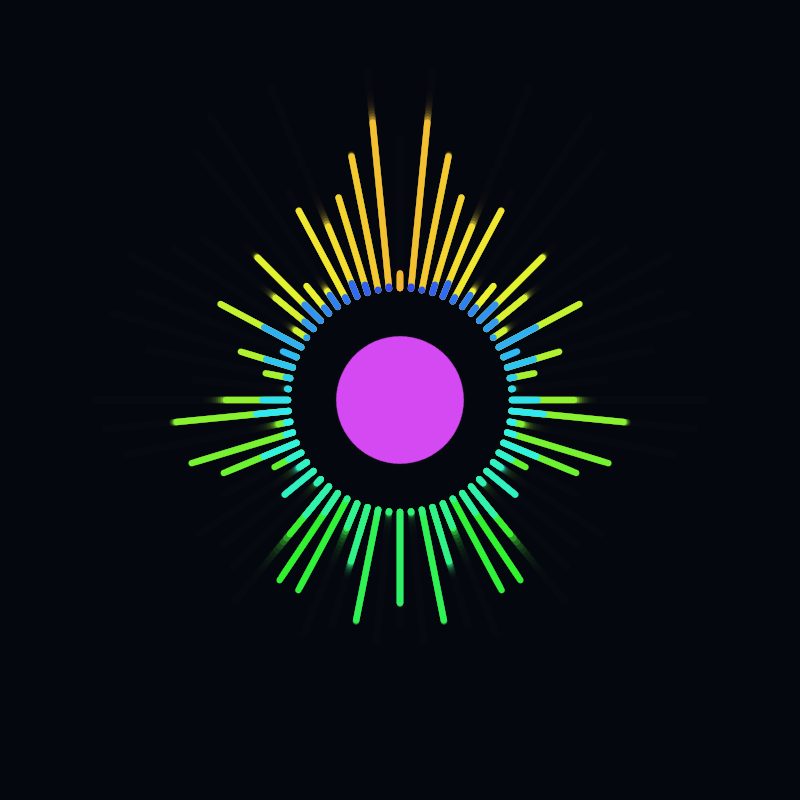
コード
上のデモの実際のスケッチ(サンドボックスで再現可能)。これで全部です。
audio-reactive/index.html
const SEED = Math.floor(Math.random()*1e9);

// Audio-reactive visualiser driven by a SYNTHETIC spectrum (no mic needed):
// a bank of sine oscillators stands in for an FFT, animating a radial
// frequency-bar ring + reactive centre pulse.
let bands, S, hueBase;

function setup() {
  randomSeed(SEED);
  S = Math.min(windowWidth, windowHeight);
  createCanvas(S, S);
  colorMode(HSB, 360, 100, 100);
  hueBase = random(360);
  // each "band" has its own frequency + phase, like a spectrum bin
  bands = [];
  const N = 64;
  for (let i = 0; i < N; i++) {
    bands.push({ f: 0.4 + i*0.03 + random(0.2), ph: random(TWO_PI), w: 1 - i/N });
  }
}

function draw() {
  background(230, 60, 6, 0.35);
  const t = frameCount * 0.05;
  translate(S/2, S/2);
  const N = bands.length;
  let bass = 0;

  // synthetic spectrum amplitudes
  const amp = bands.map((b, i) => {
    const a = (0.5 + 0.5*Math.sin(t*b.f + b.ph)) * b.w;
    const env = 0.4 + 0.6*Math.sin(t*0.3 + i*0.1)**2;
    const v = a * env;
    if (i < 6) bass += v;
    return v;
  });
  bass /= 6;

  // radial bars
  noStroke();
  for (let i = 0; i < N; i++) {
    const ang = (i / N) * TWO_PI - HALF_PI;
    const r0 = S*0.14, len = amp[i] * S*0.32;
    const x0 = Math.cos(ang)*r0, y0 = Math.sin(ang)*r0;
    const x1 = Math.cos(ang)*(r0+len), y1 = Math.sin(ang)*(r0+len);
    stroke((hueBase + i*3 + t*20) % 360, 80, 95);
    strokeWeight(S * 0.008);
    line(x0, y0, x1, y1);
    // mirror
    const ang2 = -ang - PI;
    line(Math.cos(ang2)*r0, Math.sin(ang2)*r0, Math.cos(ang2)*(r0+len), Math.sin(ang2)*(r0+len));
  }
  // bass-reactive centre
  noStroke();
  fill((hueBase + 40) % 360, 70, 95);
  circle(0, 0, S*0.12 + bass*S*0.1);
}仕組み
音を少数の制御信号に変え、視覚パラメータに対応づける:(1) 解析=入力音(マイク・ファイル・合成)に毎フレーム FFT をかけて周波数スペクトルを得て、振幅/RMS や帯域エネルギー(低/中/高)、しばしばオンセット/ビート検出も導く、(2) 平滑化=ローパスやエンベロープ追従でちらつきを抑える、(3) マッピング=信号をパラメータに結ぶ — 低域→スケール、スペクトル重心→色相、オンセット→粒子放出、スペクトル配列→変位。決定論的な生成作品では「音」自体をトークンのシードから合成(Tone.js 等)でき、再現性を保ちつつ音駆動に見せられる。
パラメータ
fftSize: number — FFT window size; the frequency-bin resolution of the analysis.smoothing: number — Temporal smoothing applied to the spectrum (0–1).bands: number — Number of frequency bands the spectrum is grouped into.sensitivity: number — Gain applied when mapping amplitude to visual parameters.
系譜
よく組み合わされるアルゴリズム
- Fragment Shader (GLSL) · 8 作品
- HSL / Hue Cycle · 6 作品
- Bezier / Catmull-Rom Splines · 5 作品
- Raymarching with SDFs · 4 作品
- Particle System · 4 作品
- Perlin / Simplex Noise · 3 作品
- 3D Mesh / Geometry · 2 作品
- Marching Squares / Contours · 2 作品
- Physics Simulation · 2 作品
- Glitch / Datamosh · 2 作品
- Instanced Geometry · 1 作品
- Wave Function Collapse · 1 作品
このアルゴリズムを使う作品 (32)

3 Minute Meditations
thetechnocratic

80s Pop Variety Pack - for experts only 🕹
daniel-catt

AlgoBeats
han-x-nicolas-daniel

AlgoRhythms
han-x-nicolas-daniel

Beatboxes
zeblocks

♫ ByteBeats
dadabots-x-kai

celestial cyclones
hideo

Crypt
the-cyclops-group

CryptoGodKing
steve-pikelny

Diggly Collects All
dca

(Dis)connected
tibout-shaik

Divergence
loren-bednar

Dopamine Machines
steve-pikelny

Dream Engine
remo-x-dcsan
Fantasía
alejandro-campos

Flux
owen-moore

Good Vibrations
aluan-wang

l.o
night-sea
Magnetosphere
robert-hodgin

Memories of Digital Data
kazuhiro-tanimoto

montreal friend scale
amon-tobin

Polychrome Music
rafael-rozendaal-danny-wolfers-legowelt

PRELUDES
trevor-paglen

Quantum Collapses
insig-t

Race Condition
jonas-lund

Rituals - Venice
aaron-penne-x-boreta

send/receive
snowfro

Synesthesia
pls-ty

Talking Blocks
remo-x-dcsan
The Reactive Square
john-maeda

Tide Predictor
lovid

Unigrids
zeblocks
最終更新 2026-07-16